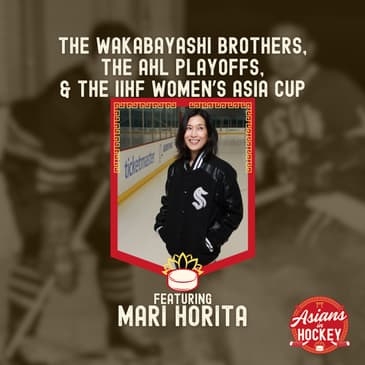




In today's episode, we recap the 2025 IIHF Women's Asia Cup, follow up with a few of our Asian players in the AHL Calder Cup Playoffs, and take a look at the lives of the Wakabayashi brothers, two hockey legends who made names for themselves in Canada, the United States, and Japan.
We also speak with Mari Horita, SVP of Social Impact & Civic Affairs for the Seattle Kraken. You can follow Mari on LinkedIn at linkedin.com/in/mari-horita-414572a
Read up on what Mari is doing with the Seattle Kraken Community through Kraken Common Thread and learn more about the One Roof Foundation at onerooffoundation.org.
Check out the "Our Stories Are Your Stories" video gallery compiling the stories of AANHPI folks in the face of anti-Asian hatred at ourstoriesareyourstories.com and watch the launch video here.
--
Don't forget to sign the petition to induct Larry Kwong into the Hockey Hall of Fame! Visit change.org/p/induct-larry-kwong-into-the-hockey-hall-of-fame-itslarrysturn to sign.
Pick up your #ItsLarrysTurn hoodie over at everythinghockey.com.
Support the podcast directly by donating at coff.ee/asiansinhockey.
Check out our recommended reading list at bookshop.org/shop/asiansinhockey. Any book purchased through this link supports the Asians in Hockey podcast without any additional cost to you.
--
Asians in Hockey is produced by Nate Nakao. Contributing producers are Chad Soon and Chris Woo. Original music by Scott Okamoto. Follow us on Instagram at @asiansinhockey, Threads at @asiansinhockey, Facebook at fb.com/asiansinhockey, and on Bluesky at @asiansinhockey.com. Email us at asiansinhockey@gmail.com.
Asians in Hockey is part of the Potluck Podcast Collective. Visit podcastpotluck.com for more.
[00:00:01] You're listening to... Woah! Potluck! Potluck! Welcome back to the Asians in Hockey Podcast. Once again, I'm your host, Nate Nakao.
[00:00:29] Before we dive into today's episode, I've got a couple quick requests to ask of you. Producing this podcast takes time, effort, and money, and I promise that you'll never have to pay a subscription fee just to listen to the podcast. But if you'd like to help out with some of the production costs, I now have a way that you can do that through buymeacoffee.com.
[00:00:50] Just visit cough.e slash Asians in Hockey, that's C-O-F-F dot E-E slash Asians in Hockey to make a donation. Also, if you've enjoyed what you've heard from us, I would love it if you could post a quick five-star review on Apple Podcasts or Spotify. This is honestly the best way to get the word out about the show and help us cultivate our audience. Thank you so much for your support. Now, as usual, we have three periods of Hockey Talk.
[00:01:18] And this week, we recap the 2025 IIHF Women's Asia Cup and the end of the AHL Western Conference Finals in the first period. Look at the lives and careers of two brothers who came out of the Japanese concentration camps to become hockey icons in the second period. And talk with Senior Vice President of Social Impact and Civic Affairs for the Seattle Kraken, Mari Horita, in the third period. All of that is coming up right after this.
[00:01:58] Hey Ryan, what's black and white and red all over? I don't know, Roman. Two nuns having a chainsaw fight? Dude, inappropriate. Come on, man. This is supposed to be a podcast promo for our secret underground podcast, Quarantine Comics. Oh, yes. Quarantine Comics. The weekly comic book club where I, ace reporter Ryan Jo, and I, mild-mannered Roman Segal, team up to discuss some of comics' greatest works. Or just some really cool comics that we've been wanting to read. From Alan Moore to Uzumaki. From Maracas to Zendaya. From Adrian Tomine to Ji Moon Yang.
[00:02:27] You might not have heard of half the stuff that we're reading. Or the other half is just pop culture superhero stuff. They could just read the books of us, Ryan. Yes, they could do that. But you could also just send us money. No, Ryan, that's not how passion podcast projects work. Why in the hell are we even doing this? Uh, I'm sure we'll be back by next week's episode. So, tune in each week to Quarantine Comics. That's qtdcomics.com. Set phasers to fun.
[00:03:01] Let's drop the puck on today's episode with a look at some of the headlines in Asian hockey. And we're starting things off with a recap of the 2025 IIHF Women's Asia Cup, which just wrapped up in Al Ain United Arab Emirates. And folks, history was made. So, what were the storylines of this tournament? To start off, the Philippines have officially arrived. They won their first ever Women's Asia Cup gold medal,
[00:03:30] defeating Iran 4-2 in the championship game. Now, this is a massive moment, not just for Filipino hockey, but for Asian women's hockey as a whole. The tournament ran from May 31st to June 6th and featured six teams. The Philippines, Iran, UAE, India, Kyrgyzstan, and Malaysia. Over the course of 15 games, we saw 106 goals scored, a total attendance of just under 1,000,
[00:03:58] and some truly inspiring play from all nations. Now, let's zero in on the champs. Team Philippines, led by scoring phenom JC Alcido, cruised through the group stage and delivered a statement 15-0 win over Kyrgyzstan. That's their biggest international victory to date. Alcido ended the tournament as the leading scorer with 24 points, putting the hockey world on notice.
[00:04:25] Their gold medal performance is part of a clear upward trajectory. They finished fifth in 2017, won silver in 2024, and now, Asia Cup champions. Iran, meanwhile, sent a young team, essentially their national youth squad, and they still went nearly undefeated in the tournament, losing only to the Philippines 4-1. That's now three medals in a row for Iran, who are quickly becoming one of the most consistent programs in the region.
[00:04:55] Also worth highlighting, Team India had their moment in the spotlight as well. They picked up their first ever win over the UAE in a 5-4 thriller and later edged Kyrgyzstan in a shootout after a 2-2 draw. And with Malaysia defeating the host nation in their final game, India won their first ever medal in international women's ice hockey. Bottom line?
[00:05:21] The 2025 Women's Asia Cup showed us that the gap is closing in Asian women's hockey. The talent is growing. The rivalries are heating up. And countries like the Philippines and Iran are proving that they can compete and win on the international stage. Now from international ice, we move to North American playoff pressure. Let's shift our focus to the AHL Western Conference Finals,
[00:05:50] where the Abbotsford Canucks took on the Texas Stars. So we're going to lock in on our four Asian players, Arshtip Baines, Jujar Kyra, Jet Wu, and Akito Hirose, for the final three games of the series. In game four on the road, both Kyra and Baines were plus one on the night, and Hirose was plus two. Despite no scoring stats for the Asians, Abbotsford stole back a game on the road, winning 5-4 in the second overtime period.
[00:06:21] In game five, still in Texas, our Asian players didn't have much of an impact on the game, and the Stars were able to grab an overtime win, sending the series back to BC. Now, back home for game six, Texas went up 1-0 near the end of the first period, and then took a 2-0 lead in the second period. Arshtip Baines cut the lead in half with a goal near the end of the second, and then in the third period, Jujar Kyra came through with the equalizer.
[00:06:50] Ten minutes later, Akito Hirose assisted on the go-ahead goal, and eventual game-winner, and with under a minute left, Baines rubbed salt in Texas' wound with an empty netter for his second goal of the night. Our Asian players were crucial in clinching the series and sending the Canucks to the Calder Cup finals to face off against the Charlotte Checkers. The finals start tomorrow, June 13th, at 7 p.m. Eastern in Charlotte, North Carolina.
[00:07:20] Don't go anywhere. We'll be right back with a look at two of hockey history's greats, the Wakabayashi brothers. Hey Brian, did you go to Saturday school as a kid? I sure did. Did you? Totally. Well, at our podcast, Saturday School, we don't teach a language, but we pass along the culture that we do know. And that's Asian American pop culture. Ada's a journalist, and I'm a professor and film festival programmer. We've watched a lot of great Asian American movies, and we want you to watch them too.
[00:07:51] Come listen to us as we look back at the pioneering films that have led us to today. Let's travel back to the early 1940s. The world is engulfed in war. In a small Canadian town called Slocan in British Columbia's interior, Japanese Canadians are being incarcerated into camps under government orders during a time of fear and suspicion.
[00:08:20] This is where Hitoshi, or Mel, Wakabayashi was born, in 1943, inside a concentration camp. His younger brother, Herb, would arrive less than two years later after the family relocated to Chatham, Ontario. From those modest beginnings came two of the most fascinating and overlooked stories in hockey history. Today, we're going to unpack the journey of the Wakabayashi brothers, from incarceration and injustice
[00:08:49] to international ice hockey stardom. Let's start with Mel. Born during one of the darkest chapters of Canadian history, he would grow up in Ontario, where sports quickly became a part of his identity. And he wasn't just good, he was exceptional. In fact, he was a standout in both baseball and hockey, even earning a spot on the Chatham All-Star Baseball team that included none other than future baseball Hall of Famer, Ferguson Jenkins.
[00:09:17] But hockey was where Mel's star really began to shine. After joining the University of Michigan Wolverines, he became a force on the ice. He earned All-American honors and was named Team MVP twice, distinguishing himself as one of the most skilled and dependable players on the roster. At just 5'6 and 150 pounds, Mel was fast, clever, and resilient. Size didn't matter. His hockey IQ and determination set him apart.
[00:09:48] Let's pause here for a moment, because Mel's time at Michigan wasn't just notable for his stats. This was the 1960s. North American professional leagues weren't exactly rolling out the red carpet for Asian players. In January 1967, Wakabayashi signed with the Detroit Red Wings and was assigned to play with the Red Wings Farm Club in Memphis, Tennessee. He played in 1967 for the Memphis Wings and the Johnstown Jets. However, as one columnist later observed,
[00:10:18] 5'6", 150 pound Japanese forwards were not in great demand in the National Hockey League. Despite his junior hockey and collegiate achievements, Mel found the door to the NHL firmly closed. Still, he didn't let that stop him. In a bold move, he took his talents overseas to Japan. Now, let's set the stage. Japan was developing its hockey program in the 1960s,
[00:10:46] but it lacked experienced high-level players who could elevate the national game. Mel joined the Japanese club Kokuro Kekaku in 1968 and almost instantly became a legend. He wasn't just scoring goals. He was helping redefine how the game was played in Japan. His impact was so profound that he eventually suited up for the Japanese national team, even representing them at the 1972 Sapporo Olympics. Just think about that.
[00:11:15] A Japanese-Canadian kid born in a concentration camp, now representing Japan on the global stage. He also became a key leader off the ice, coaching and helping build the infrastructure of Japanese hockey. His connection to the game wasn't just physical. It was deeply cultural, deeply personal. Mel understood what hockey could mean for identity, belonging, and pride.
[00:11:41] Now let's talk about Osamu Herb Wakabayashi, the younger of the two brothers, but no less influential. Born in 1944, Herb followed closely in Mel's footsteps. He also excelled in both hockey and baseball, and like Mel, he found an opportunity at the University of Minnesota Duluth before transferring to Boston University, where he truly blossomed as a hockey player.
[00:12:06] Herb played for the BU Terriers during the late 1960s and quickly made a name for himself as a skilled forward. He was a standout player who helped lead the team to multiple NCAA tournament appearances, and earned recognition for his speed and smart play, even being named MVP of the Beanpot, a New England collegiate hockey tournament. He finished his illustrious career with 90 assists, the most in interior history, and second all-time scorer with 145 points.
[00:12:36] And much like Mel, Herb was known not only for his playmaking skills, but for his speed and unrelenting drive. After college, Herb joined his brother Mel in Japan. The two brothers, together, helped raise the profile of the sport in the country. Herb, too, played for the Japanese national team, representing Japan at three Winter Olympics,
[00:13:00] 1972 in Sapporo, 1976 in Innsbruck, and 1980 in Lake Placid, where he carried the Japanese flag during the opening ceremony. These were two brothers, born in Canada, shut out of opportunities in North America because of racial barriers, who found purpose, acclaim, and home through the game of hockey in the country of their ancestry, where they weren't seen as different because of their facial features or skin color.
[00:13:29] And together, they weren't just athletes. They were coaches, mentors, cultural translators. They helped develop an entire generation of Japanese players, both through their skills and by example. Herb went on to coach and teach in Japan after retiring from international play. Sadly, he passed away in 2015 at the age of 70, but the mark he left behind is indelible.
[00:13:57] Mel, now in his 80s, remains a revered figure in Japan. In 2022, the IIHF published a glowing tribute, highlighting how Mel is still inspiring players of Japanese descent to this day. He is a bridge between cultures, a living example of resilience and excellence, and perhaps most poetically, the sport that once shut him out helped him find a deeper sense of belonging elsewhere.
[00:14:25] The Wakabayashi brothers' story is also one of identity. What it means to be Asian in a sport dominated by whiteness. What it means to carry your culture with pride in spaces that often overlook or marginalize you. What it means to forge a path where none existed. When we talk about diversity in hockey today, about the slow but growing movement to include more Asian voices and faces, it's important to look back at who got us here.
[00:14:53] The Mel's and Herbs of the world didn't just participate in hockey. They helped change its geography, its demographics, and its possibilities. Their careers ask us to imagine a more global game, one where talent isn't overlooked because of race, and where players can be both elite athletes and cultural pioneers. So what's the legacy? For Mel, it's still evolving.
[00:15:20] He's seen as a pioneer in Japan, a mentor figure to younger generations, and a symbol of perseverance. For Herb, it's one of excellence and dedication. His name etched into the story of Olympic hockey. And for the broader Asian hockey community, their legacy is a beacon. Proof that we belong. That we've always belonged. And that hockey is stronger when it reflects the world's diversity.
[00:15:49] We'll be right back. Hey, I'm Phil Yu, and you may know me from a blog called Angry Asian Man. And I'm Jeff Yang, author, journalist, and celebrity dad. We host a podcast called They Call Us Bruce, an unfiltered conversation about what's happening in Asian America. Each week or so, we host a discussion about some of the most vital and interesting topics in our pop culture and our community,
[00:16:14] bringing in guests who are shaping and informing this thing called Asian America from Hollywood to D.C. and beyond. We've got media, entertainment, food, family, politics, representation. The good, the bad, the WTF of it all. So check us out wherever you get your podcasts or at theycallsbruce.com. Peace. Welcome back to the show for the third period today.
[00:16:41] I am joined by Mari Jorita, who is the SVP of Social Impact and Civic Affairs for the Seattle Kraken. Mari, thank you for joining us here on Asians in Hockey. Thanks for having me. So to kick things off, I do want to ask a little bit about your own racial background. You are, you know, I mean, if people can't tell by your name, you are of Japanese descent, correct? Yes. Yes. I'm a Sansei.
[00:17:10] Okay, your Sansei. Awesome. And then I believe I read somewhere that your family had actually been incarcerated during World War II. And we'll come back to that in a little bit. But let's talk a bit about how you ended up in hockey.
[00:17:30] Because prior to taking on the role at the Kraken, you were at Arts Fund, which is – could you give us a little bit of background on that? Because that's something that's in Washington. And I'm just curious what goes on there. Sure. Well, the simplest way to understand Arts Fund, it's a nonprofit, a 501c3. It's like the United Way for the Arts.
[00:17:54] And so we raise money from companies and individuals and support 100-plus arts organizations in King and Pierce counties. But that's what that was. And I ran that for seven years. Oh, okay. Okay. So that's where you were when you first met the Kraken CEO. And at the time, it was – the Kraken hadn't formed yet, right? It was still sort of a nascent idea.
[00:18:21] Had the NHL announced that a Seattle franchise was opening up or – Yeah, it was in process. The franchise had not yet been officially approved. I – as a CEO of a nonprofit, a big part of my job was to meet with for-profit CEOs who might be interested in supporting our nonprofit, as any nonprofit CEO will tell you. And one of our donors who knew Todd said, oh, you need to meet Todd Lewicki. He's bringing a hockey team to Seattle. And this was the summer of 2018. And I had no idea what he was talking about.
[00:18:51] And I'm like, what? But he said, no, go meet with this guy. And so I finally managed a meeting with him and sat down with him in a makeshift office. There was probably seven people there. Like I said, the franchise hadn't been approved. No team, no name, no facility, no nothing. It was really an idea and a vision. And I was there, I mean, to talk about Arts Fund. And I didn't ask him for money since they were a nonexistent sports organization.
[00:19:15] But I wanted to make the introduction and talked about what I was trying to do at Arts Fund and serve the community in that way. And he talked a lot about what he had done at the Seahawks, at the Wild, in Tampa Bay, everywhere he's gone. Service to the community and making an impact has been at the front of everything. And so we just had a great conversation. You know, I figured I'd never hear from them again. And they called me back the next week and followed up with a conversation and said, we think there's a spot for you in our organization.
[00:19:45] And that's how it all started. That's incredible. So what was it about that conversation that actually convinced you or inspired you to make the pivot from the arts world into pro sports? Yeah, there's a pivot for sure between arts and sports. But what I was trying to accomplish or what we were trying to accomplish through each is really quite similar in that it's about community building. It's about taking care of each other.
[00:20:13] It's how can you use this vehicle of arts or sports to try to do something positive beyond just the act itself. And I was, well, I'd heard about Todd Lewicki. He's legendary in our parts. And he just had this very inspired vision of, yes, I want to bring a Stanley Cup back to Seattle. And we're going to build an incredible arena and have an amazing team and, you know, bring this whole fan base together. But more than anything, I want to do some good.
[00:20:42] I want to make a positive impact and leave this place better than I found it. And we have this unique opportunity to leverage this new enterprise to do that, you know, from the ground up. And when he asked me to be a part of that, I mean, you know, he can't really say no to that.
[00:21:02] So let's transition a little bit and we'll talk a little bit about your racial identity and kind of working in the NHL. So as Asan say, Japanese-American woman who's operating in the NHL, you know, the NHL historically is pretty lacking or has some growth to some room for growth. Yeah, I'd be happy to see it like that.
[00:21:33] Yeah. So there's room for improvement in the ethnic and gender diversity department when it comes to the NHL. How have you sort of navigated these predominantly white male spaces? What strategies have you employed to foster inclusivity within your organization at the Kraken and maybe even try to influence a little bit at the NHL at large? Yeah. Well, my first job was as a corporate real estate lawyer many, many years ago.
[00:22:02] So, you know, hockey is not the only predominantly white space. There's many of them. So I don't really – it's not that different in many ways. I think what's most important, though, is that you have an organizational culture and a commitment from leadership to create a culture of inclusion and one of respect and one of personal growth and evolution and reflection.
[00:22:27] And then it's – because you can have a very diverse organization, but if you don't have the right mindset to actually make it inclusive also, then just being diverse isn't honestly, you know, good enough. And so, like I said, this is not a new environment for me in that sense.
[00:22:45] But what I would love about this organization, what brought me here and keeps me here is there is that commitment to try to, you know, write our own – define our own version of hockey culture and organizational culture. We talk a lot about trying to build one of the most inclusive hockey cultures in the country, if not the world, and that has to start with who we are as an organization. We need to be representative. We need to be inclusive. And we need to mean it. We can't just say it. So I have been very impressed.
[00:23:14] You know, we do a lot of trainings, a lot of – I mean, deep dive trainings, a lot of conversations, and make investments too, you know, internally and then also externally to try to bring more people in. You know, make people feel welcome, make them feel part of our story, track numbers to make sure we're actually making progress. So, yeah, it is a predominantly white male space.
[00:23:40] But if you're around people who share the objective, then, you know, it's great. Yeah. Yeah. That's great. So speaking of culture that you were just alluding to, you've spoken elsewhere about the opportunity to, like, write your own sort of Pacific Northwest hockey culture. Yeah.
[00:24:03] Which there is a little bit of a Pacific Northwest hockey culture in existence, but it's not the sort of traditional hockey culture that we might think of, like, out here in the Northeast, for instance. What – how would you maybe describe that culture? And what are some ways that you are working to ensure that it reflects the diversity and values of the Seattle community? Yeah.
[00:24:32] So the commitment to inclusion is across our organization, you know, and we talk about that a lot. We want our facilities to be welcoming, to be respectful. We – in the very beginning, we're writing, you know, fan policies of behavior, what you can't wear, what you can't say. And we've also consulted from the very beginning with underrepresented communities to say, what do you want to see? How can we be good partners? What does that look like to you?
[00:24:59] And also let us know if we're not, you know, doing what we said we're going to do. And so that shows up in a lot of different ways. First, from our nonprofit standpoint – so my other job is I built an executive director of our nonprofit, which is called One Move Foundation. It's a separate 501c3 public charity, and it represents both the team and the arena. But we are an independent legal entity. We have to raise our own money every year. We have our own board and all that.
[00:25:23] We have a very strong equity focus, you know, and we were really guided by some core beliefs. And that is – those are rather that the well-being of every person is tied to the well-being of every other person. So if you're not okay, I'm not okay. And issues like homelessness and inequity of opportunity and climate change, those aren't someone else's problem. It's really our collective responsibility to solve. And so sort of that sense of we really are in this together and we have to try to solve this together.
[00:25:52] And we can't turn away from it and say, no, not our issue. And also that the health of the planet is, you know, tied to the health of humanity. So those are the basic concepts upon which we built our three pillars, which are increasing access to play, helping to end youth homelessness in our region, and advancing environmental justice. And there's reasons behind each of – why we picked each of those.
[00:26:18] But the increasing access to – actually all of them, but the increasing access to play in particular is focused on creating opportunity for kids and communities that have not historically had access to hockey. And so that is done in various ways. One, you know, we have that ice rink at Northgate, three sheets of ice. So we have a financial assistance program. We've served over 700 kids to date. 84% are kids of color. 52% are girls.
[00:26:43] We translated the financial assistance materials into five different languages to further, you know, decrease the barrier to access and to entry. We do surveys to see, like, is this – how do you feel about this? Do you feel safe? Do you feel respected? And the surveys are always very, very positive.
[00:27:01] We just completed year four of a 32-week program with the Refugee Women's Alliance where our nonprofit sends four buses out to preschool sites across Seattle to bring 80 preschool kids from the Refugee Women's Center Alliance, RIWA, to our ice flicks to learn to skate and to some extent learn to play. And then we have a big graduation ceremony in June.
[00:27:25] And then we also guarantee any kid in that program who wants to continue through our financial assistance program can continue as long as they want to with the idea that you have to start young. You have to make people feel included before they have the chance to feel excluded. And even by the time you're 10 years old, you know if you're part of something or if you're not. We had brought the black hockey truck down to a school in South Seattle for this middle school group.
[00:27:49] And our chair is Judge Richard Jones, Quincy Jones' kid brother, you know, and he was down there talking to the kids like, what do you think? What do you think about hockey? It's pretty cool, right? And a couple of the guys were like, yeah, that's not really for us. That's not really our game. And, you know, by that time early on, they realized never seen themselves in the game, never really felt part of it. And so with these kids from the Refugee Women's Alliance who are four and five years old, they're too young to ever know that maybe someone might have excluded them from something. And they own this place, like they own the ice.
[00:28:19] They love KCI, the ice plex. Like this has been their home since as long back as they can ever remember. And we love that. So that's one of the ways we're trying to change who's in the game. We also underwrite a lot of field trips for youth-focused nonprofits and title one schools. And then we take hockey to where it hasn't been. We don't expect everyone just to come to us, you know. And so there's a lot of neighborhoods that have never had any exposure to hockey.
[00:28:44] And so we've been working with public sector landowners like the county and the city and the city of Tacoma to build sport courts, multi-sport courts in their parks. So we will invest in, you know, some of the stanchions and the fencing and the branding. And we'll hire a local artist to do a local neighborhood-inspired Kraken one-roof art piece or kids in the neighborhood. And then we'll do a big launch of that. And we work with the community. It's very much like, do you want this here?
[00:29:14] And if you don't, that's okay. But we'll never ever just kind of impose ourselves because we really try to be driven by those we're trying to serve. Wow. That's exciting. And you took the words out of my mouth because I was going to ask you about the One Roof Foundation. And we'll talk a little bit more about that as well in the future or in the future, in a little bit. But I am curious.
[00:29:41] So going back a little bit, the Kraken had done a tribute to Larry Kwong during their Lunar New Year night. And that was such a significant moment, not the least of which being the fact that Lunar New Year as a celebration in hockey arenas is still a pretty uncommon thing.
[00:30:02] I know the Devils here in New Jersey do it and a couple other franchises around the area where there are some higher concentrations of Asian populations in existence. But it's relatively new. But then on top of that, the Larry Kwong tribute, that's massive.
[00:30:22] Could you talk a little bit about that, about the process behind organizing the event and maybe what kind of impact that it had on the community and even the Kraken's commitment to celebrating the diverse history embedded within hockey that we often forget about? Yeah. Yeah. So that was a very special night, Lunar New Year, which is moving forward going to be a NHPI night just to be more inclusive. Cool.
[00:30:50] I need to explain to people in my office, like Lunar New Year isn't like an Asian holiday. It's a Chinese holiday that other countries celebrate. Like I don't celebrate Lunar New Year, so we went through that whole educational process. Right, right. But no, it was really, we did it, was it our third Lunar New Year night? Right. So the league used to have this thing called Hockey is for Everyone. That was the brand of it, and they had different theme nights.
[00:31:12] So we started with that, then the league kind of transitioned what they're calling it, and we created our own version, which is kind of great because we're able to really brand it with more of the Kraken feel. And it's called Kraken Common Threads, and we have stuff on our website. But it's a bit the notion that there's, you know, it is this thread of all different colors that kind of brings us together. But we are representing many different cultures and countries and languages and generations and perspectives and ideas.
[00:31:38] And so within that, we celebrate Black Hockey History Night, Women, Pride, Hispanic Heritage, Indigenous Peoples Night. I feel like I'm forgetting something. And then obviously Lunar New Year Night or AANHPI, a night moving forward. And it's a cross-organizational effort. It is our department. It is the fan development department. It is corporate partnerships. It is ticketing. It's marketing. It's really everyone.
[00:32:07] And we approach it, especially with the cultural theme nights, like if we don't know something, we need to understand it. And so when we really, you know, when I was saying, you know, Lunar New Year Night isn't Asian general. It's more Chinese focused. We got on a call with the Wing Luke Museum, which is one of the few pan-Asian museums in the country. We did a Zoom call with all the different people in my organization who work on that night. And I said, okay, give us a tutorial on top, you know, because I'm not Chinese. I don't know.
[00:32:38] So they sat and talked about what Lunar New Year is and, you know, things that we might consider, things to stay away from, the history. And what I love is the people in my organization, they really want to learn. You know, they're not, they don't sit, we try to not sit in a room and decide things on behalf of people who aren't there. Like, you know, when it's a big deal, that doesn't work. And so. That's a good concept to have, you know, as sort of a guiding principle. Yeah. Yeah. And so like, you know, the artists we hire are always from that community.
[00:33:07] We invite people from the community. We invite leaders from the community. We invite community members. We really try to, to do it holistically and authentically. And so the Lunar New Year this past year, and we've planned like a year in advance. So Chad Soon, who you know, had emailed me sort of cold and just said, Hey, I love what you all are doing. Have you ever thought of doing something for Larry? You know, and, and obviously I'd heard his name and get dozens of incoming emails every day.
[00:33:37] Like, I don't know what to do. But when he did that and then, and we were right about to start planning this night. And so I just brought it to the cross departmental group. I'm like, Hey, so Chad reached out. He wrote this book. Larry's obviously a huge figure. Is there a way we can do something at this night? And, and everyone's like, let's talk about it. Let's figure it out. You know, nobody was like, no, no, that's not our thing. Or we already have it all planned out. Let's talk about this. And so what we were able to do is corporate partnerships helped fly out his daughter, you know,
[00:34:06] and we put her up in a hotel and hosted her at the game and other people came to the game. And then, yeah, we did a tribute in the game. And in his name, we, you know, so we did a little video tribute to him. And then in his name, we made a $32,000 donation to the local 2010 international district, which is like almost all, you know, Asian restaurants and businesses and nonprofits. So it's a, it's a very threatened neighborhood.
[00:34:32] And so we, we funded two large neighbor, not large, but two of the more major neighborhood groups there in his name, friends of Little Saigon and Skipto, which is a development authority. And then Alaska Airlines that was sponsoring that night held a reception beforehand and invited their AANHPI ERG, plus a lot of leaders. And our artist, who's a Filipino woman, Sheila Hufana, she spoke.
[00:34:57] And then Larry's daughter had a moment to, you know, say if you or she wasn't clamoring for the spotlight, but had that opportunity. Um, and it was just, I, I, I think the, you know, the response we got was really positive. People felt very seen and, and uplifted and celebrated, which is the goal of these nights. And also to just raise awareness, um, for people who are less familiar with these stories. Wow. That's incredible. I wish I could have been there. It was pretty, it was fun. It was fun. Yeah.
[00:35:27] Um, so going back a little ways, um, and going back to like your, your family history, um, your mother's family was among the, uh, Japanese Americans incarcerated at the Minidoka War Relocation Center during World War II. Um, I, I'm curious to know how perhaps your, your family's history has maybe influenced your approach to social impact, um, and your commitment to equity inclusion in your role with the Kraken and beyond. Yeah.
[00:35:55] Well, you know, when, when something like this hits so close to home, it can't help but have an impact on everything. Like just who I am and what I do and how I see the world. I also think it's my mom's experience. My dad's family had to move, but they moved. Okay. So everyone had to move. You didn't move by a certain time. Then the government moved you. But you know, a lot of my parents, my mom's parents, I don't think necessarily could read English or even knew it was happening.
[00:36:20] But I think their experiences is a big part of what inspired me to go to law school, um, really to understand our legal system, to ensure that it can advance justice rather than impede justice. Um, because, you know, we know very well, it's not a given. And we're very reminded, uh, at this moment in time that our civil liberties are way too fragile and, um, we need to understand how to protect them.
[00:36:46] But we also need to, I think, combat fear and ignorance with, um, understanding and compassion. I mean, at the end of the day, like we need to, we need to figure out how to bridge that divide somehow so that manifests injustices like the incarceration don't continue to repeat themselves. And I don't know if I sent you, um, the link to the, our stories or your stories. Um, no, I don't believe I, I got that. I'll send that to you.
[00:37:15] So, um, it, it is, um, in, since we're, you know, talking about Asian month, uh, in March of 2021, after the Atlanta shootings, um, a group of women, five of us got on a call. Cause people were very upset and feeling, you know, angry, sad, isolated, just helpless. And so they're like, we need to do something like, okay, well, I'm not creative. So I'm just going to listen. And there's a former producer on the call and a former ad agency founder on the call.
[00:37:45] We're all mothers. We're all, you know, professionals. And they said, let's do a website and do some video interviews of some Asians, like black Asians, Native American Asians, you know, Hispanic Asians of all generations and, and life experiences to tell the story of, of Asians in America. And we called it our stories or your stories, because a big part of what we're trying to do is convey that a, we are not a monolith, but also all humans have shared experiences.
[00:38:14] And, and we really, these, you know, artificial constructs to divide us are so damaging and so destructive. And they are in fact, artificial. They've been created over time to push people apart. And so the goal of, you know, there's a lot of stop AAPI hate movement going on at the time. And, and that was important, but it was also came with a lot of, I think, anger. And so understandable, totally justified, but we were trying to approach this with a little bit more of a, can we try to heal, you know? And so we created this website.
[00:38:43] There's an awesome two minute PSA you should watch. We'd actually won several national awards. And the first person we reached out to talk to is a guy named Doug Baldwin, who is a very well-known, a hall, I don't know if he's hall of famer, but he's a world, oh my gosh. What's the, I'm getting all the, but not world cup, Superbowl champion. Oh, okay. Okay. Yeah. Doug Baldwin is a receiver on the Seattle Seahawks, like just really well-known here, beloved, amazing guy. He's a quarter, I don't know if he's a quarter, but he's a grandmother who's Filipinos. Okay.
[00:39:13] And most people don't know that because he presents as black. And I call, I said, would you be part of this? And so he was the first person to tell his story. Then we had Yuji Okamoto, who was an actor from Karate Kid. We had a former governor. And then we had like a lot of, you know, people that nobody knows, but we had the Karexican, Korean, Mexican. We had the Native American, Scottish, Chinese person.
[00:39:31] So, so it was a pretty cool effort to, to kind of say like, let's, let's try to find some understanding and compassion and love here to, to get past this hate. But I'll send you that link. Yeah. Yeah. Okay, great. And I'll put the link in the, in the show notes for today's episode as well. Um, and yeah, no, I, I, I agree. I think you need both.
[00:39:53] Um, I think having the opportunity for people to, um, to just express their anger, their fear, their frustrations, um, and take action as a result of that. But also having the opportunity for people to not necessarily escape those, uh, those feelings, but a place where it can be, um, uh, honed into something different, you know, and, and people process their pain in, in so many different ways.
[00:40:23] And so having both avenues, I think is, is so, is so crucial and so vital. So thanks for sharing. And we'll definitely put that in the, in the show notes for people to, to check out. Um, so reflecting on your, your tenure with the Kraken since 2018, um, what initiatives are you, uh, perhaps most proud of? Um, and how do you measure the success of, uh, the Kraken social impact programs? Yeah. Yeah.
[00:40:47] Well, there's, my job is a little unusual in that it is social impact like DE&I or whatever we're supposed to call it these days. Oh, right. Plus the foundation and the philanthropy. So it's a, and other things as assigned by my boss, but so I'm proud of a few things. One on the, the inclusion piece of it. Um, we've done a lot of deep dive trainings with our leadership group, which is, you know, predominantly cisgender, straight, white, male.
[00:41:13] And, um, I am, I don't want to say impressed by, but I'm, um, pleasantly, I would say surprised in, in how open people have been to really try to learn and, and evolve. Because I know that when you get to a certain level of power, like why bother? Right. You don't need to, you don't need to change your mindset. You're fine. And, and the fact that so many of the leaders in our organization will sit down for eight hours.
[00:41:41] We have this guy come in for eight hours over two days with our top leadership, including our GM and our owner and just go deep on, you know, privilege and bias. Wow. And yes. And people listened and people came up later and like, okay, get it. You know? And that was like, and not to men. And we've got another group of leaders, men when I have gone like to do multi-day offsites. So I think that's pretty unusual. You know, it's not like a one hour. We're just going to sit there and pretend we listen.
[00:42:10] This is like deep stuff. And, and we continue to do this. And, um, I have to say, I, I'm, um, I was not expecting that. And I can see the change it's made. And I, I love that. Like, I wouldn't say I'm proud of it for me. I'm just proud of it for our organization. Um, you know, go ahead.
[00:42:30] Oh no, I was just going to say, um, and from the outside looking in, um, as far as the various franchises across the NHL, it, I do get this sense that, uh, the Kraken as an organization is, um, on the whole. A bit more forward thinking than the average, uh, across the, uh, the NHL. Yeah. Well, we hope so.
[00:42:57] I mean, you know, we're newer, so it's, it's a little bit easier because we're not outdated mindsets. You know, we, and, and, and because I mean, not to bring it all back to Todd, but he's a huge part of creating the culture here. And, and he had this vision to do something different in that. He really genuinely cares about everyone, like equally, whether, whatever race you are, whatever position you are. And that's unusual for a person in his position. He came from very humble beginnings and he has not lost touch with that at all. In fact, I think he embraces it and that makes a difference.
[00:43:27] And no, we absolutely are thinking toward the future all the time. And like I said, because we're so new, it's a little bit easier because you don't have to shed sort of that, you know, we've been doing this over and it's fine mindset. It's not like, no, we got to run and go and facing a million challenges. And so that's, those are the kinds of people who are drawn to this organization. I'm also proud of our nonprofit, One Way Foundation. Like everything else, whatever, you know, four seasons ago, we were just an idea on a, literally a whiteboard. We had no money, we had nothing.
[00:43:55] In fact, we had some obligations we were supposed to fulfill, which I didn't learn about until after I got hired. Like, okay. But, you know, now we have a board, a newsletter, a website, social media channels. We have an audit. And, you know, most importantly, we're making an impact. I did sketch a few things down. We provided financial assistance, like I said, to over 700 youth. And, you know, really succeeded in bringing new communities into the game. That number I cited of over 80% BIPOC and 52% girls.
[00:44:23] The four years of 32-week programming for REWAF, 300 kids from that program. We partnered with Parks Department of King County, Seattle, and Tacoma to build multi-sport courts and under-resourced neighborhoods. We've underwritten hundreds of field trips and donated thousands of tickets, equipment, and curriculums to nonprofits and title-one schools. We led the first ever, actually, all-pro-team pooled fund in Seattle ever, raising $500,000 to support play equity in our region.
[00:44:48] We raised over $4.5 million for organizations providing shelter support and job training for unhoused youth. We, including one of the things we did is we also bought 3,500 pounds of food with our mascot buoy to do a Thanksgiving event at a local food hub for a really under-resourced school. We provided emergency funding to families displaced by king tide floods when they had no one else to turn to, and the city and the county couldn't respond fast enough.
[00:45:16] We purchased air purifiers for every learning space at a local elementary school because they have really polluted air. We underwrote grant writing support for grassroots nonprofits to access state and federal funding for environmental justice grants, and we parlayed $70,000 into over a million dollars in support. We partnered with Climate Pledge Arena and the Urban League to purchase and install water stations, providing potable water for a school that didn't have water for its kids, and then we bought 700 co-branded water bottles for them.
[00:45:43] We provided $90,000 in capacity-building grants for statewide environmental justice alliances in light of what's happened in the federal funding decrease. We've done a lot of neighborhood cleanups. We've invested in play fields. And we've won a bunch of awards from the Green Sports Alliance, Aspen Institute, Puget Sound Business Journal, and Polestar, et cetera, et cetera. So in four years, we're peeling pretty good. That's a lot.
[00:46:09] And the other thing I would say in my other duties as a sign bucket, a group of us, including our CEO, have taken on this project to partner with the city and the Seattle Public Schools to redevelop, really rebuild a 77-year-old dilapidating stadium that was falling apart, and it's in the middle of the Seattle Center Park, and it's been a problem for 30 years.
[00:46:29] And so we agreed to come out as the third leg of that cross-sector stool, which includes millions of dollars of in-kind support, and then we also led a $30 million capital campaign to close the public funding gap. And so that was just like a little extra project we did last year to raise that money, and we're going to be breaking ground this year. Wow. Well, we look forward to hearing more about that. That's really exciting. Yeah.
[00:46:54] So for anyone who is perhaps aspiring to lead social impact initiatives or might be leading a social impact initiative within sports organizations or even outside of sports organizations,
[00:47:07] what's maybe one or two pieces of advice you might offer, especially for anybody coming from non-traditional backgrounds, whether or not traditionally located within that sports community or maybe coming from a racial background that might not be –
[00:47:27] I mean, I guess that's redundant. Sorry. Maybe not a community that's necessarily an identity embedded within that community or from outside of the sport itself, like you coming from the arts, for instance. Yeah. Yeah. I think it goes back to what I said earlier is it's so important to work in a place where they have the right culture and a real commitment to this work.
[00:47:54] Because so often I'll see in sports and elsewhere, people go into this type of work, and if there really isn't an authentic commitment to do it, you know, to really get stuff done, it's hard. And then it's frustrating and then people fail. So really understanding before you commit to an organization to say, do we actually have alignment and values in what we're trying to accomplish?
[00:48:19] And does the leadership actually really care and want to make a difference? Because if you're – those are really strong headwinds otherwise. In sports, I think in a good way – and I've been on some – I was on a group for the Robert Wood Johnson Foundation when we were looking at health equity last year.
[00:48:38] And there is – it's not a really steep trend, but I would say increasingly teams are looking at social impact work versus just community marketing initiatives. I think historically a lot of times marketing would move over to community, which is a very overused term. But it was like – and it's not bad, you know, but it's like let's go to a school and take a picture.
[00:49:03] Let's go to a hospital and take a picture versus what are the real issues in our community and society that we might be able to help with? And how do we work in and with those communities in a way that is helpful to them, which is more impact versus marketing? And we've – again, because we're new, we've been able to sort that out pretty well over the – you know, so we kind of clearly define what goes into fan development, what goes into Wonder Foundation, and where do they overlap?
[00:49:31] And there's lots of partnerships, but it's clear which communities – who's serving whom. And I think that if you can – if people really want to do social impact work, understanding what a team – how a team defines community and how a team defines impact is important because to different teams they mean very, very different things. Yeah, of course. And for various communities they mean very, very different things, whatever city that team might be embedded in.
[00:49:59] And so, yeah, having your ear to the ground and paying attention to what's going on within that community is so key. Yeah. So your career has spanned law, the arts, now professional sports. How have these diverse experiences shaped your leadership style and your approach to driving social change? Yeah. I always tell my daughter and her friends, like, don't worry about your major.
[00:50:28] It's like – and people will be like, we want to know how you got to your job. I'm like, yeah, I don't think you really want to follow my path. It's not exactly correct. So it is a very wide-ranging, I guess, career. But the same principles, I think, apply. You know, I think you just – to me anyway, it's really important to always work hard, to treat people well, to listen to them, to try to – as a leader, to provide support and help bring people up.
[00:50:55] To do what you say you're going to do and to stand – you know, if you claim to stand for something, then you actually have to stand for it, particularly in social impact work. And then to have a good dose of humility, I mean, particularly as a leader. So, you know, I'm constantly learning. I think humor. Humor is really important to be able to laugh at yourself and also a situation.
[00:51:21] At least that's my coping mechanism because sometimes it's – you're going to laugh or you're going to cry. And you kind of – Right, right. So I think all of that, but then surrounding yourself with people who support you, people who inspire you, people who you can learn from, that's really important because being in the wrong culture or with the wrong team can be very distracting and exhausting if it's toxic or if, you know, it's constantly trying to fix those things.
[00:51:48] And then you're not able to really focus on the impact you're trying to have. Right. And that's across any industry. Yeah, that's so true. It's been my experience as well. So before we wrap things up, I do want to ask a couple quick questions. First of all, is there anything that you want to plug, any work that you're doing that you want to mention here?
[00:52:17] Of course, we'll be putting links to everything in the show notes, but anything in particular that you want to mention before we wrap up? Nothing to plug particularly. Absolutely. Obviously, like, you know, for people who are interested in learning more about our theme nights, just because they are kind of – I think they're really well done. We do have that on our websites, Kraken Common Threads, and we usually do a video about the artist, and the artist gets to tell their story of what inspired them to do a particular design.
[00:52:44] But I've just heard from so many people that that's really interesting. So I suppose that there are people out there who aren't familiar with the Kraken that might be interesting to them. Yeah, and then just come to a game. Cool. If I'm ever in the Seattle area, I will certainly be doing my best to make it to a Kraken. Oh, please do. Give me a heads up and definitely let me know. Yeah, we don't have a stitch lot, but I'll let you know when AA and HPI month is. Awesome. Awesome.
[00:53:13] And then finally, for anybody who is in the Seattle area, how can they get involved with One Roof Foundation, maybe coaching, mentorship, education, even donating? Where do people turn to for that kind of stuff? Is there anything that you're looking for? Well, One Roof Foundation, we have a website, so onerooffoundation.org. You know, as a lot of nonprofits will tell you when they have very tiny staffs, which is us, it's hard to manage volunteers, except for like in-game 50-50 raffles, which is not always what people are looking to do.
[00:53:44] Obviously, donations are always welcome. But as much as anything, maybe even getting to know some of the organizations we support to see if those are resonant. Like if they're like, well, we like you, but we don't really want to support One Roof. We work with a ton of very important, hardworking nonprofits, most of whom are struggling right now and facing some, you know, unexpected public sector funding challenges. And so I just think, honestly, whether it's here in Seattle, now's the time to lean in and to help those organizations out because they really need it.
[00:54:13] Yeah, yeah. Oh, 100%. Well, Mari, thank you so much for joining us on Asians in Hockey. This has been a fantastic conversation. And do stay in touch. Don't be a stranger. Yeah, no, thanks for doing this. I love it. Asians in Hockey, right? Absolutely. Absolutely. Well, thanks again. Yeah. Talk to you soon. Have a great day. You too.
[00:54:40] Okay, that does it for today's episode of the Asians in Hockey podcast. Stay tuned for our next episode where I chat with Ava Wood, PWHL super fan and digital content creator. Ava has a ton of insight on life as a PWHL content creator, so be sure to subscribe so you don't miss our conversation. Thank you so much for listening. Asians in Hockey is part of the Potluck Podcast Collective and is hosted and produced by Nate Nicale.
[00:55:08] Contributing producers are Chad Soon and Chris Wu. Original music by Scott Okamoto. If you like what you heard, please leave us a five-star review on Apple Podcasts or Spotify and share this podcast with your friends. To keep up with us on socials, follow us on Instagram and threads at Asians in Hockey and on Blue Sky at Asians in Hockey dot com. You can also find us on Facebook at Facebook dot com slash Asians in Hockey.
[00:55:36] And please feel free to shoot me an email at Asians in Hockey at Gmail dot com. See you next time on the Asians in Hockey podcast.