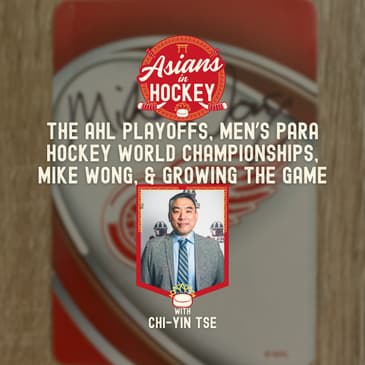




In today's episode, we recap the 2025 Men's Para Ice Hockey World Championship, follow up with a few of our Asian players in the AHL Calder Cup Playoffs, and take a look at the life and career of Mike Wong, the first player of Chinese descent drafted to the NHL.
We also spend some time chatting with Chi-Yin Tse, Coach and GM of the Tulsa Oilers JHC. You can follow Chi on Instagram @ctsehockey.
Check out his organization, the Tulsa Oilers at tulsaoilers.com.
--
Don't forget to sign the petition to induct Larry Kwong into the Hockey Hall of Fame! Visit change.org/p/induct-larry-kwong-into-the-hockey-hall-of-fame-itslarrysturn to sign.
Pick up your #ItsLarrysTurn hoodie over at everythinghockey.com.
Check out our recommended reading list at bookshop.org/shop/asiansinhockey. Any book purchased through this link supports the Asians in Hockey podcast without any additional cost to you.
--
Asians in Hockey is produced by Nate Nakao. Contributing producers are Chad Soon and Chris Woo. Original music by Scott Okamoto. Follow us on Instagram at @asiansinhockey, Threads at @asiansinhockey, Facebook at fb.com/asiansinhockey, and on Bluesky at @asiansinhockey.com. Email us at asiansinhockey@gmail.com.
Asians in Hockey is part of the Potluck Podcast Collective. Visit podcastpotluck.com for more.
[00:00:01] You're listening to... Woah! Potluck! Potluck!
[00:00:29] Welcome back to the Asians in Hockey Podcast. Once again, I'm your host, Nate Nakao. Now, before we dive into today's episode, I do have a quick request for you. If you've enjoyed the series thus far, I would love it if you could post a quick five-star review on Apple Podcasts or Spotify. This is honestly the best way to get the word out about the show and to help us cultivate our audience. So thank you so much for your support.
[00:00:54] As usual, we have three periods of hockey talk featuring a recap of the 2025 Men's World Para Ice Hockey Championships, a review of some of the Asian players still competing in the AHL's Calder Cup Playoffs, a profile on the first player of Chinese descent ever drafted to the NHL, and a conversation with Chi-Yin Tse, the coach and GM of the Tulsa Oilers Junior Hockey Club.
[00:01:22] All of that is coming up right after this. Life gets a little crazy sometimes. Sometimes it's confusing, sometimes it's funny, sometimes it's beautiful, and sometimes it can just piss us off. Enter First of All Podcast. It's a safe space for real conversations about the things that we all struggle with, celebrate, contemplate, and work through in our daily lives.
[00:01:51] I'm your host, Mindy Chang. I'm an actor, filmmaker, and entrepreneur with a colorful background, full life, and brilliant friends who I love to unpack life with to share with all of you. They are everyday people like you and me, ranging from award-winning artists, cultural icons, powerful CEOs, my hilarious childhood friends, and even my mom. Tune in for honest conversations on mental health, dating, sex, family, career, culture, and everything in between. Listen to First of All Wherever You Find Podcasts, part of the Potluck Podcast Collective.
[00:02:28] Let's drop the puck on today's episode by recapping the 2025 Men's World Para Ice Hockey Championships that just wrapped up in Buffalo at the end of May. At this year's tournament, the teams representing Asia were China and South Korea, who both showcased their growing prowess in the sport, delivering notable performances throughout the tournament. China continued its ascent in para ice hockey by securing a fourth-place finish,
[00:02:57] marking its third consecutive year in this position at the World Championships. China opened the tournament with a strong performance against South Korea, winning 6-3. And demonstrating offensive prowess, they dominated in their second match of the preliminary rounds, blanking Germany 8-0. In the final game of the group stage, China fell to the defending champions Canada 4-2.
[00:03:23] Now, with a 2-1 record in the group stage, China advanced to the semifinals. Facing the host nation and eventual champions, China was overpowered in the semifinal match, losing to Team USA 6-1. And in a thrilling overtime battle, they narrowly missed out on the bronze medal, falling to Czechia 2-1.
[00:03:48] China's consistent top-four finishes underscore its rapid development and competitiveness on the international stage. Now, South Korea faced challenges in the tournament, but showcased resilience and determination throughout. In their opening match, South Korea was bested by China 6-3.
[00:04:11] Facing a formidable Canadian team, South Korea suffered a significant defeat, falling to the defending champions 12-0 in their second group stage game. In their final game of the preliminary round, South Korea narrowly lost Germany in overtime 3-2. With these results, South Korea moved on to the classification rounds.
[00:04:37] In another tight match, they were edged out by Slovakia in overtime, 1-0. Concluding their tournament on a positive note, South Korea secured a victory over Norway 2-1 to claim 7th place at the tournament. Now, despite these setbacks, South Korea's perseverance and final win highlight the team's potential and commitment to growth in para ice hockey.
[00:05:07] Now, switching our focus over to stand-up hockey, let's take a look at what's going on with the Abbotsford Canucks, who are led by head coach Manny Malhotra, who we featured in a career profile two episodes ago, and who have several players of Asian descent on the team. The Canucks made it to the Western Conference Finals of the 2025 Calder Cup playoffs, where, at the time I'm recording this, they are currently leading the Texas Stars 2-1 in a best-of-seven series.
[00:05:36] Taking a look at our Asian players on the squad, let's start with Arshteepe Baines. The South Asian forward has been a consistent presence in Abbotsford's lineup, contributing to the team's depth scoring and forechecking efforts. So far in the series against Texas, Baines has four assists for four points. Next up, Jujar Kyra.
[00:05:56] Also of South Asian heritage, Kyra brings veteran experience and physicality to the Canucks forward group, playing a crucial role in both offensive and defensive situations. Kyra has one assist in this series so far. Next, we have Jet Wu. Of Chinese and Matisse descent, Wu has been a steady force on the blue line, providing reliable defense and contributing to the team's transition game.
[00:06:22] Unfortunately, the AHL doesn't track hits and blocked shots on their website, so I'm not able to provide any defensive stats for Wu. Finally, we have Akito Hirose. The Japanese-Canadian defender did not play in Game 1, but in Game 2, he scored the game-winning goal in a thrilling shutout win. He remains quite the force on the blue line for the Canucks.
[00:06:46] Now, I'm going to leave it there for this period, but if you know of any other players of Asian descent still competing in the Calder Cup playoffs, please let me know by emailing me at asiansandhockey at gmail.com or sending me a DM on Instagram at Asiansandhockey. When we return, we'll take a look at the life and career of Mike Wong. Stay tuned. Hi, I'm Charlene Kay.
[00:07:15] I'm a musician, songwriter, and guitarist. Growing up, I loved music. Whether it was pop, acoustic, emo, I ate it all up. But as a Chinese-American kid living in Scottsdale, Arizona, I also felt isolated, never really seeing artists who looked like me or shared my experiences. So, after years of performing on stages all over the world, I wanted to create a space to highlight the amazing Asian musicians who I knew were out there, just not always getting played on the radio.
[00:07:42] That's why I started Golden Hour, a podcast where Asian singers, songwriters, instrumentalists, and music producers share their personal stories. And it's a space for you to discover your new favorite artist. Listen to Golden Hour with me, Charlene Kay, wherever you get your podcasts. Part of the Potluck Podcast Collective. Born on January 14, 1955 in Minneapolis, Minnesota,
[00:08:08] Mike Wong emerged as a significant figure in American ice hockey during the 1970s. Standing at 6 feet 3 inches and weighing 204 pounds, Wong played the center position and was known for his left-handed shots. Of Chinese and Native American descent, he holds the distinction of being the first player of Chinese heritage to be drafted into the National Hockey League.
[00:08:35] Wong's athletic journey began at Burnsville High School in Minnesota, where he excelled at multiple sports. He was a three-sport letter winner, earning All-State honors twice in football and once in hockey. His versatility and dedication laid a strong foundation for his future endeavors in sports. Additionally, Wong showcased his prowess in boxing, becoming a Minnesota Golden Gloves champion, a testament to his diverse athletic abilities.
[00:09:04] After high school, Wong played junior hockey with the Minnesota Junior Stars in the Midwest Junior Hockey League during the 1973-74 season, recording 24 goals and 32 assists in 57 games. His performance caught the attention of national selectors, leading to his inclusion in the U.S. national junior team for the inaugural World Junior Championships in 1974, held in Leningrad. Although the tournament was unofficial at the time,
[00:09:34] it marked a significant milestone in international junior hockey, and Wong's participation highlighted his growing reputation in the sport. The following season, Wong joined the Montreal Bleu Blanc Rouge of the Quebec Major Junior Hockey League, or QMJHL, where he tallied 27 goals and 41 assists over 67 games. His performance in the queue further solidified his status as a promising talent in North American hockey circles.
[00:10:03] In 1975, Wong's hockey journey reached a pivotal point when he was selected 77th overall in the fifth round of the NHL amateur draft by the Detroit Red Wings. Notably, he had also been chosen 32nd overall in the 1974 World Hockey Association, or WHA, amateur draft by the Indianapolis Racers. Opting to pursue his career in the NHL, Wong began the 1975-76 season
[00:10:33] with the Kalamazoo Wings of the International Hockey League, where he impressed with 20 goals and 22 assists in 39 games. His performance earned him a call-up to the Detroit Red Wings, making his NHL debut on October 11, 1975, against the California Golden Seals. During his stint with the Red Wings, Wong played 22 games, recording one goal and one assist.
[00:11:01] Despite this limited scoring, his presence in the NHL was groundbreaking, setting a precedent for players of Asian descent in professional hockey. Following his time with the Red Wings, Wong continued to play in various minor leagues. He returned to the Kalamazoo Wings for part of the 1976-77 and 77-78 seasons, contributing significantly to the team's offense. Additionally,
[00:11:30] he played for the Rhode Island Reds in the American Hockey League and the Muskegon Mohawks in the IHL. In the 1978-79 season, Wong joined the Johnstown Wings of the Northeast Hockey League, where he notched 18 goals and 26 assists in 53 games. After a professional career spanning several teams and leagues, Wong retired from professional hockey in 1979. After retiring,
[00:12:00] Wong returned to Minnesota, where he remained active in the hockey community. He played for Buck's Unpainted Furniture, a U.S. senior elite team based in Bloomington, Minnesota, for several years. Beyond playing, Wong dedicated himself to coaching youth hockey, particularly in Lakeville, Minnesota, where he served in various coaching and program directing roles for 18 years. His commitment to nurturing young talent underscored his passion for the sport
[00:12:28] and his desire to give back to the community. In recognition of his contributions to sports and his pioneering role in hockey, Wong was inducted into the Burnsville High School Hall of Fame in 2024. His induction celebrated not only his athletic achievements, but also his impact as a trailblazer for players of diverse backgrounds in hockey. Mike Wong's journey through professional hockey during the 1970s stands as a testament
[00:12:58] to perseverance and breaking barriers. As the first player of Chinese descent drafted into the NHL, he paved the way for greater diversity in the sport. His experiences highlight the challenges and triumphs of minority athletes in professional hockey, serving as an inspiration for future generations. Mike Wong's story is one of determination, skill, and a pioneering spirit. From his early days
[00:13:28] as a multi-sport athlete in Minnesota to his groundbreaking role in the NHL and his lasting impact on youth hockey, Wong's legacy is firmly etched in the annals of American hockey history. After the break, we'll be chatting with Chi Yinsi, coach and GM of the Tulsa Oilers Junior Hockey Club. We'll be right back. Hey, Candice!
[00:13:58] We are so excited to have you join me and Kathy for a brand new season of the Korean Drama Podcast, the podcast about watching Korean dramas by people who don't watch Korean dramas. I'm so excited to join the podcast, but where's Kathy? She said she'd meet us here. Kim! I'm Candice! I'm right here! Um, why is Kathy's voice coming from this chicken meatball? So, funny story, I was so busy watching Korean dramas on my phone to prepare for this podcast that I accidentally walked into a mysterious machine and got turned
[00:14:28] into food. And, excuse me, Kim, I'm obviously a chicken nugget. Agree to disagree. Well, that's a weird coincidence because for our fifth season of the Korean Drama Podcast, we're watching the comedy sci-fi series Chicken Nugget. Join us each week as we discuss the highs and lows of chicken nugget episode by episode. So, grab a snack, maybe not chicken nuggets, and follow us on your favorite podcast app, part of the Potluck Podcast Collective. You're totally gonna eat me,
[00:14:57] aren't you? For the third period of today's episode, I am joined by Chi Yin-Chi, coach and GM of the Tulsa Oilers Junior Hockey Club. Chi, welcome to the Asians in Hockey Podcast. Thanks for having me. I appreciate you reaching out. Yeah, absolutely. So, we'll kick things off with your sort of personal background, your cultural background. You have a unique
[00:15:27] path in hockey, including a background in bioengineering. So, what drew you into the sport and how did your cultural identity shape your journey? Sure. I actually grew up in New Jersey and one of the things for me, I grew up playing every sport and I wasn't good at every sport but I definitely played every sport and one of the things for me was I was a really big baseball fan and there was a baseball strike and when that strike happened, I kind of gave up
[00:15:57] on baseball and I turned to hockey. A couple of my friends were playing street hockey and they got me on the sport and from there it's where I am now. So, I just learned to play hockey just from one major league encounter. Wow. That's pretty cool. What part of Jersey did you grow up in? I grew up in Livingston, New Jersey. It's about 15 minutes from Newark. Gotcha. Gotcha. I actually work in Newark. I grew up in Morristown and I currently live
[00:16:26] in Southern Bergen County right now. But, yeah. Awesome. So, let's talk a little bit about your coaching philosophy. Sure. So, you had mentioned before we hit record ecological dynamics and constraints-led approach in your coaching. For our listeners who are unfamiliar, could you briefly explain what those mean? Yeah. So, ecological dynamics really is kind of like it's a theory, right? So, it's psychology-based
[00:16:56] and it refers to the way that your body moves and how you react to it. So, the principles of it is called non-linear pedagogy. It's the way we learn. The theory is, again, ecological dynamics. Ecological dynamics and then the methodology is constraints-led approach. So, if you think about it as how kids learn and how kids play the game, we have this opportunity to give environments where kids can learn better
[00:17:25] or faster instead of a normal practice where you might have, let's say, a team out there and they're just doing line skating to start. And so, what does line skating actually do, right? So, most people say, well, it gets better at edge work and they learn their edges better that way and I would argue that we're not being efficient with the ice times, right? So, ice times are being maybe, what, $500 an hour average across the country and in that hour,
[00:17:55] do you really want to spend 30 minutes on skating? And then, possibly deterring kids from learning or deterring kids from wanting to play the game further. So, we look at it as, hey, in that hour, let's hide skating, right? So, what's a really fun way to get kids to learn edges? Can you think of anything? Can you think of a game that would... I mean, you could play some games with them. You could throw a soccer ball out there.
[00:18:24] So, specifically, if you're not throwing a soccer ball or a hockey puck out there, what kind of game would you play? You've probably played a bunch. We could do, you know, Sharks and Minnows. Sharks and Minnows is a great one. Yep. Oh, I forgot the name of it. Like, landmines are kind of thing where, you know, the kids are skating across and the coach... Well, okay, sorry, there's no pucks involved, right? Yeah. But, yeah, Sharks and Minnows, some tag, I guess. And so, tags... Tag is probably
[00:18:54] the best one, right? And so, in tag, you can put in a bunch of different rules or constraints and that allows the kid to learn whatever they need to learn and whatever you want them to learn, right? So, I can say, hey, let's stay in this small space here and in the face-off circle and, you know, Joey, you're going to be the tagger. Everybody else has to skate backwards. Joey can skate forwards, right? And so, we can still teach everything that we want but without actually saying, hey, you're going
[00:19:24] to put your feet back underneath you and you're going to push out 45 degrees and you're going to push your toe out and you're going to have this perfect line from the middle of your body out and that'll teach you the skating stride, the proper skating stride. But everybody's different, right? Everybody skates differently. You're not going to skate like Connor McDavid and you're not going to skate like Sidney Crosby or you're not going to skate like, you know, Nathan McKinnon, right? I just named three Canadians and I'm wearing a USA hat. Right? But at the end of the day,
[00:19:52] we have a way that we can teach kids more efficiently and more effectively and we just have to understand how to utilize the environment to our advantage. That's good to know. Yeah. I'll actually take that with me onto the ice next time. So, I mean, you've, in that you've sort of kind of answered this next question already, but maybe more pointedly and more specifically, how do these frameworks
[00:20:21] sort of influence your player development in, let's say, a non-traditional market like Tulsa? Sure. And I would treat almost everything the same, but different, right? Like, so I know, I know that where I grew up in New Jersey, hockey wasn't big when I was a kid and I take kind of that experience with me to wherever I go. I lived in Minnesota for a little bit and hockey's huge, but I can tell you that all across the country and maybe across the world,
[00:20:50] one of the biggest complaints we hear is there's no hockey IQ. Kids don't have the hockey IQ. And so within the constrained slide approach, we can put kids in an environment where they're developing faster brain speed just because they're being put in environments where they have to think a little faster and think a little better and that's one of the things that I take with me here. And in Tulsa, one of the things that's great about here is we've actually had hockey here since 1928. So it's not,
[00:21:20] it's not unknown, but they definitely don't have as big of a youth hockey culture as maybe some other cities or other markets. But the kids here enjoy it and they really love it and people who were here to help keep youth hockey going along have done a fantastic job of keeping them alive. My job here is just to keep it growing. And then one of the things that we want to get people to understand is, yes, it is an invasion sport, but we want to stay away
[00:21:50] from the, now what I would say is traditional way of coaching hockey. And we want to move into this new era of developing hockey players to be athletic and to be learning and to be making decisions on their own. Yeah. Yeah. That's really great. And I also think of like, you know, how in non-traditional markets there's probably a smaller population of kids that have already learned how to skate. I know,
[00:22:19] at least around here, especially nowadays with the sort of boom in New Jersey hockey over the last 20, 30 years, I've encountered quite a few kids that already get onto the ice having some skating experience. I would imagine that down south that's probably less common. So you're starting from a little bit of a higher learning curve, I suppose. Yeah. Yeah. So one of the biggest entries to Barry Riverside's cost
[00:22:47] is the ability to skate, right? And so one of the big things that for us and my objectives is, well, let's just introduce them to the sport, right? It doesn't have to be on the ice. Maybe it's street hockey. Maybe let's get them into street hockey, put a stick in their hand and keep teaching. But we can't just keep a stick and can't just put a stick in their hand and say, okay, here's a hockey stick and here's a ball and go play hockey. Right. You have to be consistent and you have to show up every day and you have to show up or every week
[00:23:17] and be consistent in how you develop that love for the game. Otherwise, the kids won't do it on their own. So with that, actually kind of popped another question into my mind. What are some of the, I suppose, cultural differences that you see within the game across the different places that you've been? So like Minnesota, New Jersey and Tulsa, Oklahoma. Yeah. I'd say hockey etiquette is different.
[00:23:47] Right. In every state, I've lived in five states and hockey etiquette has changed in every area mostly because it's generational. Right. So, you know, coming from New Jersey to Massachusetts, going from New Jersey to Massachusetts, hockey culture was a little bit different. Right. Where it was and it was also back in the day. So there was a little bit more more violence involved. but there was definitely like a different mindset. Then when I moved
[00:24:16] to California from Massachusetts, it was definitely more, there were a lot of transplants and so the transplants were able to bring a little bit of hockey culture to it but the newer generation of families who weren't in the sport already, they were kind of getting, you know, learning, learning, just learning like how I did but we were able to create some sort of dynamic within our facility and then going to Minnesota
[00:24:46] and watching hockey, it was just different. Like, everybody played hockey. There was, you know, there was generations upon generations of hockey players so the etiquette was there, the playing style was always going to be the same. There wasn't anything new and there's do's and don'ts in every area and then moving down to Tulsa, it's just been, it's kind of like how I grew up where the hockey mindset is a little bit behind but we're doing our best to educate and move forward. Nice. So,
[00:25:15] I want to shift a little bit and, you know, since the title of the podcast is Asians in Hockey, I am curious about your role as an Asian American. So, as an Asian American in a leadership role in hockey, have you encountered any unique challenges or even opportunities that others in the game might not see or experience? Yeah, I think I've definitely held, I've had those kinds
[00:25:45] of experience, I think. One of the biggest shocks for me is like growing up on the East Coast in Livingston, we had a larger Asian population of my brother and my sister are older than me and they were like the first Asians in their classes. Wow. Yeah, and then I grew up on the side of town where we didn't really have as many Asian families. So, growing up through grade school it was basically, you know, a handful of families. And then getting into high school,
[00:26:16] both of our middle schools kind of combined into our high school. Okay. So, there was an influx of Asians because they were generally on the other side of town and so that was hard for me to kind of interact with and it was weird. I didn't really understand the role of what your basic culture is or your ethnicity is and how it like can really kind of shape your youth. And so, moving there from to Boston
[00:26:46] and then moving to California. So, California was actually the big eye-opener for me where I could walk on the street and, you know, everybody looks like me and I'm not the minority, right? Yeah. And that was kind of cool and living there was a different cultural experience. I got to, you know, coach a bunch of different Asian families and so, our facility was in Oakland and we had a huge Asian population which was really cool to see all these little kids out on the ice who,
[00:27:15] you know, they got a chance to finally see like, oh, somebody looks like me and one of the unique things for me too is I got to work in Chinatown and in Chinatown I got to grow a little street hockey program there and so, that was actually, that was fun for me, right? Getting those kids from street hockey over to the rink to skate and then having some of those kids turn into the little hockey players and actually some of them are now pretty good hockey players. Nice. It's cool. It was very, very cool to see and I think, you know, just being a part of it too,
[00:27:45] from that I got to go to Willio Reskills Weekends and then from the Willio Reskills Weekends I met a bunch of different organizations, across the country but most notably I got to meet Willio Reskills and then from there I got to be, I got selected into this board called the Carnegie Initiative and was able to meet different, different walks of life and different types of people and I think that was probably one of the coolest experiences for me that hockey brought
[00:28:15] me to and then just, you know, just in the hockey world it's always, it's always a challenge and you're always trying to look for the next level up. Yeah. Sometimes you have to make lateral moves to move up but at the end of the day you're just making, you're networking and you're making relationships with everybody. so I don't really know if that answered your question. No, no, that's fine. But it definitely, you know, my path has been different and
[00:28:44] I appreciate everything that I've gone through. Yeah, absolutely. And yeah, you shared some of those opportunities and experiences that you had specifically because you're an ethnic minority in the sport of hockey which, you know, currently is still a pretty white dominant sport but I am curious, do you think, as far as your perception of the game, do you think that the visibility of Asian leaders in hockey is improving
[00:29:15] and what more do you think can be done in the sport to foster this sort of inclusive leadership across various ethnic and even gender barriers? Yeah, I would say that I think the sport's really growing, right? And so when you look at it and if I'm looking at it just from the United States perspective, like I see a lot of kids in the North American League who are coming over from Korea or they're coming over from Japan and, you know, there's definitely some Chinese kids out there too but, you know,
[00:29:45] you see some of those kids and now they're signing contracts like there's one kid from North Iowa who just signed the contract to go to play in the KHL, right? And then there's some other kids growing up and, you know, I think if we expand our vision and we look across the globe, the sport has grown so much, right? Yeah. South Korea, phenomenal hockey players. And, you know, I was just in Taiwan a couple years ago, maybe two years
[00:30:14] ago and I saw a hockey billboard which was freaking cool for me, right? Like, man, I just want to see, I want to go. I was on vacation with my parents but, you know, I was like, oh, let's try and figure out where this is. And then, you know, looking at China when China was hosting the Olympics, they built a bunch of hockey rinks and they were trying to promote their sport and get a bunch of guys to go over and coach and get a bunch of, you know, ex-college players, ex-pro players and just build out their KHL team and, you know,
[00:30:44] you look at it and the sport's awesome and it's growing and I think with the amount of players that are now involved, we'll see more people kind of fill into those leadership roles. For me, I wish that Paul Carrera was still involved in the game and to a larger extent, right? Like, he was basically the face of our generation and just watching him play and, you know, I was a Devils fan so it kind of
[00:31:14] stinks. But, you know, Paul Carrera was Paul Carrera and, you know, Jim Pack and Larry Kwong, right? So, those kinds of names don't translate over time right now and hopefully with your podcast and, you know, some of the other information that's out there, those names get put out into the world and then you'll see more players who move into the managerial roles
[00:31:44] or coaching roles. So, I think it's coming. Absolutely. It's coming. It's just going to take a little bit. Yeah, I do agree. I think it's going to take some time. It's going to take some concerted effort, but we are seeing it more. I mean, the captain of the Montreal Canadians, Nick Suzuki, you know, is one name and face that's out there that hopefully over time will sort of influence more and more kids who look like us to join in the game. Yeah, even Jason Robertson,
[00:32:14] right? Yeah, exactly. Jason Robertson, Nicholas Robertson, you know, the Cody Sisi actually I discovered recently is also part Filipino. So, so let's transition a little bit and talk about Tulsa as sort of a non-traditional hockey market. Now, what are some strategies that you have found effective in growing the sport locally and regionally in an area that's not known for its
[00:32:43] hockey history per se, though you did mention that hockey's been there since 1928. I am curious about perhaps some of the off-ice stuff because we did talk about like the on-ice strategies, but what about off the ice? Street hockey. That's really where it kind of lands, right, is being able to interact. I just actually did a street hockey event today with a camp and for us it's just getting, teaching the counselors. You got to teach the counselors and you got to make sure you check in with
[00:33:13] them and how they run their camps and how they run hockey and make sure that kids love the game. That was my message to the counselors today was, hey, when you guys go through this and teach it to the kids, you got to make sure the kids love the game. It doesn't have to be hockey right away, but there's little minute things within the game that we can kind of enhance for their experience and then now they put a stick in their hand and they can be even better at it. And then just making sure you get to all the elementary
[00:33:43] schools. So our junior team, we were able to visit a couple schools last year and introduce floor hockey and gyms and we'll do some more of that this year and just touch points. Always making sure you connect back with the teachers or with the students and making sure that they connect back with the players. And that's how you grow the game. And those are, I guess, some of your community outreach strategies. How big of a role does that community outreach play in building that sort of sustainable hockey
[00:34:12] culture in a place like Tulsa? It's huge. It's huge. We need everybody to kind of buy in. We need everybody to have that mindset of, hey, I want to make sure I get to connect with 10 players today. And within those 10 players, we want to see them in our facility in the next year. And then from the next year, if they build that relationship with myself or my staff or the players, they start to love the game and enjoy the game. And every time they walk into those doors,
[00:34:42] the experience for our objective is to make sure their experience is great. And so, you know, whether it be for a public skate or a stick and puck or, oh my gosh, hey, that's Coach Chee. He was at our school all year last year doing street hockey or floor hockey. And, you know, my job is to go over and make sure I remember their name. Right? Making a connection with the community is really important for us, not just our association or our program,
[00:35:11] but for the sport. Do you see, I'm going a little bit off script here, but I'm curious, do you see an approach to developing and educating parents in the game? Because we're talking about a culture that has sort of grown and existed for many decades, even a century up in Canada and states like Minnesota and even in Massachusetts, but in
[00:35:40] Oklahoma, there isn't really that sort of parent hockey IQ of, you know, how do we put all this equipment on our kids and so on and so forth? Do you see your role in kind of building and educating parents as well? Yeah, it's a really good question. And one of the things I always forget about is the parents. So truthfully, it's a hurdle that I've been trying to jump over the past year. I've gotten some more parents involved.
[00:36:10] Actually, most of the guys that played, they played roller hockey here. And so they're really on the same wavelength as me is how we think about the game. So that's nice. But just getting them to kind of buy into the other stuff. And then having parent meetings, right? The parent meetings are important before your season starts or during your season, making sure everybody buys in and understands what's going on. And then with our learn to play program, we call it the little oilers. Okay.
[00:36:40] The objective is always, hey, I know you're new parents. We'll help you get the gear on. But we want to start getting the kids into the locker room. We want to start kids. We want to see kids carry their own bags. We want to see kids start putting on their own equipment. Yeah. There's a lot of that we see is like, hey, you know, you're six or seven and parents are fine. That's fine. They can lace up your skates, but you should be able to put on your equipment or at least a couple times and then let's let the kid do it. So we're
[00:37:10] teaching and we're learning. Yeah, absolutely. Yeah. Absolutely. Isn't that the case with everything? Yes. Yes, very much so. You've alluded to some of this already, but I am curious how you approach introducing the sport of hockey to families who might be completely unfamiliar with the game or who don't bother because they don't necessarily see themselves represented in the sport. Yeah. I mean, I mean, you can, you'll see me out and about and I know, I think yes, the other day I
[00:37:39] was actually in our local donut shop and a police officer walked in with his son and you know, he's a young black kid and he's six years old and for five years old actually. And I looked at his dad and was like, hey, should your kid play hockey? And he said, no. I was like, well, does he want to play hockey? And he was like, nah, it's not really our sport. And I was like, well, you know what? Give it a shot. Like there's nothing that you can't do. But if you're playing all these other sports, you might as well just throw this other sport in there. But most of it is
[00:38:10] always, you know, if parents or kids are like, I don't really want to try to do it. Hey, come to this session. I'll give you equipment. And if you don't love it, that's fine. But I guarantee that you're going to at least enjoy your time being here. So just just making sure that you're always presenting an opportunity for every kid. And family. Absolutely. So let's go back in time a little bit. And as as somebody who was a big NWHL
[00:38:39] slash PHF fan for a number of years while the league was still exist in existence. I mean, I had the Riveters right in my backyard here. So and I got the chance to befriend a few of the Riveters players. I coached with a couple of them as well. So the NWHL was like a really big part of my sort of awareness and growth in in the game as an adult. And you had spent time with the Minnesota Whitecaps as their their GM for a while. Could you tell us a
[00:39:09] little bit about that and and maybe, you know, experiencing women's hockey at this incredibly transformative time? What were some key lessons that you took from that role? Yeah. So before I took the role, I was I was working in girls hockey in San Jose. And so I did about two, two to three years working there in the girls program. I took over as their girls director and I really enjoyed my time working with with those players. And and I was able to work a national camp with
[00:39:38] USA hockey at the 15th camp a couple of times. And I'm just learning, learning the role and learning the environment of girls hockey. I thought it was really interesting. And I thought the growth of girls hockey was amazing at that time. And obviously still is right now. It's growing even faster. And then so when I took the role with Minnesota, I was I was I was looking for something different. Right. I loved coaching. Coaching was was fun for me. But the general manager role was like, oh, man, I don't really know if
[00:40:07] I'm qualified to do this. I've never even thought about it. But it turned out to be pretty, pretty, pretty fun. So, you know, there's a little bit of hockey ops, a little bit of contract negotiations and talking. And then I'm scouting hockey was probably my favorite part going to watch all those college hockey games and watching players and tabbing players for hey, this is the player that we kind of want to sign next year. And let's see what happens. And building a roster based off of based off the
[00:40:36] salary cap, it's kind of cool. So, you know, it's like I think it's like every I don't know if it's every kid's dream, but but definitely like having an opportunity to build a roster based off of a salary cap was kind of fun. Yeah. Yeah. But I mean, any kid who has spent more than an hour a day on cap friendly dot com. Yeah. Yeah. Yeah. And, you know, there's a lot of things that go into it where people don't really think about like built again, building relationships
[00:41:05] and networking with agents. I think that was that was new for me and I was like, well, this is really interesting and how how it's always also interesting to see the skewed views, right? Like, you know, some players may think they're worth more and, you know, as much as I want to pay them that kind of money, it's it's it's based off of, hey, I have to build a roster based off this much money that I have. It's nothing personal. This is a business. And I think that was a hard shift for me is saying, you know,
[00:41:35] shifting in mindsets of like I'm a really player centered coach. And and so when when I was trying to negotiate with players like, wow, it's really hard to like negotiate with this player because I really like this player and I think they would do great. I just can't afford to give them that kind of money. So that was that was interesting. But the the lessons I learned from there are are definitely just more more related in networking, right? And just being able
[00:42:05] to communicate a little better one on one or, you know, with a with an advisor versus an agent trying to communicate that way or trying to talk to players about their abilities versus, you know, judging players by their abilities. Right. And so I don't I don't judge the players, but you know, they're, you know, kind of walk them through their what I'm seeing and what I'm feeling and and how I can approach it is definitely an experience for me. But it's definitely a
[00:42:34] lesson to help me go into the other side of it, which is the boys junior side. Cool. Yeah. So walking through that transition a little bit from a leadership standpoint, how did your work with the Whitecaps then influence your role today and what you're doing with the the Oilers Junior Hockey Club? Yeah, I think, you know, I was asked to take the director of hockey role down here in Tulsa. And when I took it, then they then they sprung it on me that there was going to be a junior team and they
[00:43:04] were going to need a GM. And so somebody threw my name in the hats because I had an experience as it with the Whitecaps. And so I took it on and I said, hey, this is this is great. You know, I don't have to work. I don't have to deal with agents and I'll have to deal with players who think they own, you know, they should get more money than we can afford and whatnot. But it actually turns out it's pretty much the same. So it's it's definitely a challenge, right? Trying to build a new organization based off of all the kids that you see across the
[00:43:34] country and all the events. And I'm trying to convince players that Tulsa is a great place for hockey and our facility is fantastic. You know, you're kind of a salesman, but you're still learning how to kind of entice people to play junior hockey here. And I think it's a great experience for me and hopefully helps me move forward and upward into another role. Before we wrap things up, I am
[00:44:03] curious about your just kind of some thoughts that you might have for young Asian talent, whether that's players or aspiring coaches or front office folks. What's some advice that you would give to them, to anyone who wants to kind of build a place for themselves in the hockey world? Don't have a chip on your shoulder. And I think I think people like to use the chip on their shoulder as an excuse. I definitely had a
[00:44:32] chip on my shoulder for a long time, which forced me not to be able to make as many connections as possible. And also, it kind of, I think it cost me a couple bridges too. Just thinking that in the back of your mind, you feel like somebody's always going to leapfrog you in some sort of capacity and you think it's because you're, you know, you're Asian or you're a minority and you're not going to get this job because of that.
[00:45:02] And I would argue that keep learning, be in, have an open mind and ask a lot of questions and have a lot of passion for the, for the sport and have a lot of passion for where you want to be. And, you know, always reach out to somebody else to ask questions for opinions. Don't just, don't just use your own opinions as, as guidance. I mean, I think that's a, that's a life lesson. And, you know, really just, I'd say put your head
[00:45:31] down and work, but that's not really the way it works. Like, you really have to get out there and network with people and make sure that you keep those bridges open. And then, you know, things will come along. Somebody will, somebody will think of you and say, oh man, I really enjoyed having that conversation with this person. I think they'd have a good role. So it's there and it's coming. I think, you know, you also have to remember too, there's only a certain amount of jobs out there. Right. So, you know, you look at the junior landscape, there's
[00:46:00] only what, 40 head coaching positions. And you look at the NHL, there's only 32 head coaching positions. You look at college hockey, there's only 60. Sorry, I was referring to the North American League, but right. And you look at, you look at these positions and there's only so many, but if, if you feel like there's other positions within the organization, right? Like maybe it's a video coach. Maybe it's a volunteer assistant coach. Maybe you're a goalie coach. But those are also opportunities and one
[00:46:30] day those opportunities will help. So get as much experience as possible. That's some good advice. Well, gee, thank you so much for coming and hanging out with us today. Before we close up, is there, where, where can people find you online if they want to reach out or follow up with you? And is there anything that you want to plug, any programs or organizations that you want to plug here on the show? Sure. I'm pretty active on Instagram. It's just C, TSE,
[00:47:00] hockey. And then sometimes I'm on Twitter. But plugging, you know, I'll plug my organization, my junior team. We're an NA3 team down here in Tulsa. And we're building and we're expanding. And our owner is awesome. And he's, he's really giving me the green light to, to kind of help grow our organization with, from our little others program to our junior program. And we also own the ECHL team down here. So we are, we are
[00:47:29] devoted to the, to the hockey scene. And there's a lot of, there's a lot of moving parts, but I think, I think people will be surprised about what's going to happen down here in the next five years. Awesome. Awesome. little forecasting or foreshadowing. Okay, well, we'll, we'll keep our, we'll keep our eyes on, on what's going on in Tulsa. Yeah. Sounds really exciting. All right. Thanks again, Shi. Yeah, no problem. Appreciate you having me on here. Okay.
[00:47:59] That does it for today's episode of the Asians in Hockey podcast. Stay tuned for our next episode, where I chat with Mari Horita, the senior vice president of social impact and civic affairs for the Seattle Kraken. I had an absolute blast chatting with Mari, so be sure to subscribe so you don't miss it. Thank you so much for listening. Asians in Hockey is part of the Potluck podcast collective and is hosted and produced by Nate Nacal.
[00:48:28] Contributing producers are Chad Soon and Chris Wu. Original music by Scott Okamoto. If you like what you've heard, leave us a five-star review on Apple Podcasts or Spotify and share this podcast with your friends. To keep up with us on socials, follow us on Instagram and threads at Asians in Hockey and on Blue Sky at Asians in Hockey dot com. We also have a Facebook page now, facebook.com slash Asians in Hockey. And please feel free to shoot me an email at Asians in Hockey at
[00:48:58] gmail dot com. See you next time on the Asians in Hockey podcast. podcast. We'll see you next time on Bye. Bye.