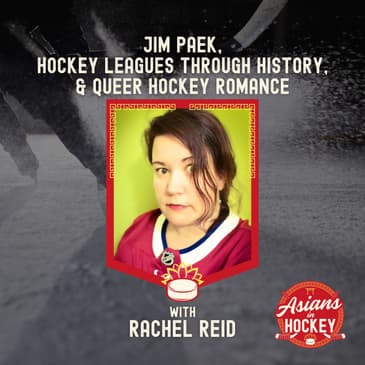




Today's episode covers some Asian hockey history; an overview of some hockey leagues throughout history—including a look at some of the recent developments in women's hockey; and a conversation with Rachel Reid, author of several hockey romance novels, including the series that gave us the Heated Rivalry television series, Game Changers.
You can find Rachel on Instagram @rachelreidwrites, and you can find all her novels on her website, rachelreidwrites.com.
--
Don't forget to sign the petition to induct Larry Kwong into the Hockey Hall of Fame! Visit change.org/p/induct-larry-kwong-into-the-hockey-hall-of-fame-itslarrysturn to sign.
Pick up your #ItsLarrysTurn hoodie over at everythinghockey.com.
Check out our recommended reading list at bookshop.org/shop/asiansinhockey. Any book purchased through this link support the Asians in Hockey podcast without any additional cost to you.
--
Asians in Hockey is produced by Nate Nakao. Contributing producers are Chad Soon and Chris Woo. Follow us on Instagram at @asiansinhockey, Threads at @asiansinhockey, Facebook at fb.com/asiansinhockey, and on Bluesky at @asiansinhockey.com. Email us at asiansinhockey@gmail.com.
Asians in Hockey is part of the Potluck Podcast Collective. Visit podcastpotluck.com for more.
[00:00:01] You're listening to... Whoa! Potluck! Potluck! Potluck!
[00:00:15] Welcome back to the Asians in Hockey Podcast. Once again, I'm your host, Nate Nakao. Now, before we dive into today's episode, I do have a quick request to ask of you. If you've enjoyed the series thus far, I would love it if you could post a quick five-star review on Apple Podcasts or Spotify. This is honestly the best way to get the word out about the show and to help us cultivate our audience. So thank you so much for your support.
[00:00:44] Now, as usual, we have three periods of hockey talk. In the first period, we'll take a look at the life and career of Jim Paek, one of the pioneers of the game for players of Asian descent. In the second period, I'll give you a little bit of a primer on the history of a few other elite-level non-NHL hockey leagues. And then, in the third period, we'll have a conversation with the author Rachel Reid, who wrote a series of hockey romance novels on which an upcoming TV series is based.
[00:01:13] All of that is coming up right after this.
[00:02:13] We'll see you next time. Okay, let's drop the puck on today's episode. So we'll start things off with a profile on one of the legends of Asian hockey.
[00:02:38] Before Paul Correa or Nick Suzuki ever wore the Captain's C, before Jason and Nicholas Robertson lit up the scoreboard in Dallas and Toronto, there was Jim Paek. For Asian hockey fans, especially first-generation immigrants, Jim wasn't just a player, he was the proof.
[00:02:58] The proof that someone with a Korean name, Korean roots, and an Asian face could not only play in the NHL, but win and win big. Jim Paek was born in Seoul, South Korea, in 1967. His family immigrated to Canada when he was just a year old, settling in Toronto, where hockey was more than just a sport. It was a cultural institution.
[00:03:27] His entry into the game wasn't driven by a dream of the NHL, at least not at first. Jim started playing hockey simply to follow in his older brother's footsteps. It was about bonding, fitting in, making friends in a world that still often saw him as an outsider. Now that first pair of skates became a lifeline. The rink became a second home.
[00:03:52] And as the years went on, it became clear that Jim wasn't just playing hockey. He was good at it. But his journey wasn't without balance. His parents, like many immigrant families, were deeply supportive of his hockey career, but always grounded in values. Education came first. His mother famously attended 106 of the 107 junior games he played with the Oshawa Generals. The one she missed? A snowstorm.
[00:04:22] His father, meanwhile, made a lasting impression when Jim signed his first professional contract with the Pittsburgh Penguins. He insisted the deal include four years of paid tuition and books, a safeguard for his son's future, because he knew how unpredictable this sport could be. That dual sense of drive and discipline would define Jim's entire career.
[00:04:48] Jim played three seasons in the Oshawa Generals, where he developed into a reliable, no-nonsense defender. He captained the team in his final year and led them to the OHL championship and a berth in the Memorial Cup. In the 1985 NHL draft, he was selected 170th overall by the Pittsburgh Penguins, a long shot by any measure. But Jim was never phased by the odds. Jim was never phased by the Pittsburgh Penguins. He also spent three seasons in the International Hockey League with the Muskegon Lumberjacks.
[00:05:15] He wasn't a flashy player, but he was consistent, composed, and coachable. Traits that NHL teams crave on their blue line. Eventually, he earned his shot. And when he got to Pittsburgh, he made it count. Jim Pack made his NHL debut during the 1990-91 season. That spring, during the playoffs, something incredible happened.
[00:05:40] In Game 6 of the Stanley Cup Final, with the Penguins on the verge of their first-ever championship, Jim scored his first NHL goal. And not just any goal. It came in the closing game of the series. Assisted by Mario Lemieux, no less. The Penguins won the Cup that night, and Jim Pack became the first player of Asian descent to hoist the Stanley Cup.
[00:06:07] In one of those rare storybook moments in sports, every young Asian kid who loved hockey saw themselves on that stage. And he did it again the following year, winning a second Cup in 1992, cementing his legacy as a back-to-back champion. He would go on to play a total of 217 games in the NHL, suiting up for the Penguins, the Los Angeles Kings, and the Ottawa Senators.
[00:06:35] Now, over that span, he tallied 34 points. Modest stats, to be sure, but that wasn't his game. Pack was a stay-at-home defender. A team-first player. The guy who did the little things and the dirty things. The kind of guy who made good teams great. Now, while Pack himself hasn't been inducted into the Hockey Hall of Fame, his Penguins jersey is enshrined there, a permanent acknowledgement of his place in the game's history.
[00:07:05] After leaving the NHL, Jim played professionally in the IHL, and even took his talents overseas to suit up for the Nottingham Panthers in the UK before retiring in 2003. But his hockey journey was far from over. Jim moved into coaching, starting behind the bench with the Orlando Seals of the WHA2 before finding a long-term role with the Grand Rapids Griffins, the AHL affiliate of the Detroit Red Wings.
[00:07:34] There, he helped develop young talent and earned the respect of a new generation of players. In 2013, he helped guide the Griffins to their first-ever Calder Cup, proving once again that his value extended far beyond his own playing days. But perhaps the most meaningful chapter in Jim's story began in 2014, when he was appointed head coach of the South Korean men's national team and director of hockey for the Korea Ice Hockey Association.
[00:08:05] At the time, South Korea was not considered a serious hockey nation, but under Pak's leadership, that changed dramatically. He introduced North American-style systems, and he emphasized discipline, speed, and fundamentals, and he instilled a belief in his players that they could compete. In just a few short years, his work culminated in a historic milestone. South Korea qualified for the 2018 Winter Olympics hosted in Pyeongchang.
[00:08:35] For Pak, it was a full-circle moment. The country of his birth, the sport of his life, and the chance to lead a national team onto the Olympic stage. That moment wasn't just about medals. It was about visibility, representation, pride. South Korea may not have medaled, but they won something arguably just as important. Respect. Jim Pak's legacy goes well beyond the ice.
[00:09:05] His story resonates with so many of us. Not because he was the flashiest or the most famous, but because he showed that with hard work, family support, and belief in yourself, you can build a path where none before existed. He was the first. The first Korean-born player in the NHL. The first Asian player to lift the cup. And now, one of the first to build an entire nation's hockey identity from the ground up.
[00:09:32] There are more Asian players in the game today than ever before. They all know his name, and they all owe their careers to him. Jim Pak isn't just a part of hockey history. He's changed it. We'll be right back. Hi, I'm Charlene Kay. I'm a musician, songwriter, and guitarist.
[00:10:02] Growing up, I loved music. Whether it was pop, acoustic, emo, I ate it all up. But as a Chinese-American kid living in Scottsdale, Arizona, I also felt isolated, never really seeing artists who looked like me or shared my experiences. So after years of performing on stages all over the world, I wanted to create a space to highlight the amazing Asian musicians who I knew were out there, just not always getting played on the radio. That's why I started Golden Hour,
[00:10:29] a podcast where Asian singers, songwriters, instrumentalists, and music producers share their personal stories. And it's a space for you to discover your new favorite artist. Listen to Golden Hour with me, Charlene Kay, wherever you get your podcasts. Part of the Potluck Podcast Collective. For today's second period, we're taking a step outside the NHL to explore some of North America's lesser-known, yet hugely influential, hockey leagues.
[00:10:57] While the NHL remains the dominant force in pro hockey, the sports history and future have been shaped by other leagues that challenged its structure, provided new opportunities, and reimagined how the game could be played. So let's dig into four of them. The WHA, the CWHL, the NWHL slash PHF, and the brand new PWHL. First up, the World Hockey Association.
[00:11:28] Launched in 1972, the WHA was a bold competitor to the NHL, aiming to disrupt the hockey establishment. And it worked. But for a while. The WHA lured away big-name NHL talent with higher salaries and looser player rights, most famously Bobby Hull, who signed an unprecedented $1.75 million contract with a $1 million signing bonus. The league also made waves by opening doors
[00:11:56] for international and marginalized players. Jerry James and Val James, for instance, were amongst the first black players to break into the league. The WHA also welcomed players from Eastern Europe years before the NHL truly began to globalize. The league's championship trophy was the Avco World Trophy. Although the WHA ceased operations in 1979, its legacy endures, notably through the NHL's absorption
[00:12:25] of four WHA teams, the Edmonton Oilers, the Hartford Whalers, the Quebec Nordiques, and the Winnipeg Jets. Now, let's shift our focus to the women's game, exploring leagues that have been pivotal in advancing women's professional hockey. We'll start with the CWHL, the Canadian Women's Hockey League. Founded in 2007, the CWHL was a pioneer in organized women's professional hockey.
[00:12:54] Its goal was simple but ambitious, build a sustainable, competitive league where the best women players in the world could shine. Throughout its existence, the league had teams based in Toronto, Montreal, Calgary, Boston, Ottawa, Burlington, and even China. For most of its existence, the CWHL operated on a semi-professional model. Players were not paid until the league's final two seasons.
[00:13:22] Still, it attracted top talent, including Olympians like Marie-Philippe Houlin, Megan Agosta, and Hillary Knight. The league's championship trophy, the Clarkson Cup, named after former Governor General Adrienne Clarkson, symbolized the pinnacle of women's hockey excellence. Among the league's standout players was Julie Chu, a Chinese-American forward who played for the Montreal Stars, later renamed Les Canadiennes de Montréal after a partnership with the Montreal Canadiens,
[00:13:52] was signed. Chu's illustrious career includes multiple Olympic medals with Team USA and a significant impact on the growth of women's hockey both on and off the ice. Head back to episode two of the podcast to hear more about her life and career. Unfortunately, despite increasing popularity, the CWHL folded in 2019, citing financial instability. But it laid the groundwork for what came next,
[00:14:22] particularly the players' push for a league that truly treated them as professionals. Now on to the NWHL, later rebranded as the PHF, or Premier Hockey Federation. Launched in 2015, the National Women's Hockey League made history by being the first professional women's league in North America to pay its players. Starting with four teams, Buffalo, Boston, Connecticut, and New York,
[00:14:51] the league expanded to six and later seven teams, including franchises in Minnesota, Toronto, and Montreal. In 2021, the league rebranded as the PHF to reflect a more inclusive identity and to move away from gendered naming. Former player Harrison Brown put it this way, I was extremely proud to play in the NWHL, but when I was asked where I played hockey by strangers, it would give me anxiety to state the full league name
[00:15:20] and essentially out myself. This is a very important move for non-binary or trans hockey players. The PHF's championship trophy, the Isabel Cup, honors Lady Isabel Gathorne Hardy, daughter of Lord Frederick Stanley, of Stanley Cup fame, and one of the first known women to play the game. Miei Dench, a Japanese-American forward, was a notable player in the NWHL. After a successful collegiate career
[00:15:50] at Harvard where she was a top scorer, Dench played for the Metropolitan Riveters, contributing significantly to the team's success and lifting the Isabel Cup herself after assisting on the cup-winning goal in 2018. During its run, the NWHL slash PHF pushed for equity in hockey, raising salary caps, negotiating media deals, and expanding viewership. But internal rifts between the PHF and the Professional Women's
[00:16:20] Hockey Players Association, or PWHPA, created a divided landscape. In 2023, the PHF was bought out, effectively dissolved, and its players absorbed into a new, unified vision. That brings us to the PWHL, the Professional Women's Hockey League. Founded in 2023 and launching its inaugural season in January 2024,
[00:16:49] the PWHL is the first major, fully professional, unified, women's hockey league backed by significant investment, including from Air Canada and Canadian Tire. The league began with six teams in Toronto, Montreal, Ottawa, Boston, Minnesota, and New York. It drafted players from around the world, including American and Canadian Olympians, and signed them to real, livable contracts with benefits, union representation,
[00:17:18] and multi-year deals. It's a historic step forward for the women's game. And excitingly, the league has announced expansion teams in Seattle and Vancouver, set to debut in the 2025-26 season. The PWHL's championship trophy, the Walter Cup, was introduced in 2024. The trophy was crafted in partnership with Tiffany & Company, symbolizing a new era for women's hockey. One of the PWHL's trailblazing players
[00:17:47] is Akane Shiga from Obihiro, Japan. In the league's inaugural season, Shiga played for PWHL Ottawa, later the Ottawa Charge, becoming the first Japanese player in the league's history. Her participation during that first season not only showcased her talent, but also highlighted the growing international diversity in women's hockey. Now let's settle on the PWHL for a few minutes here. I want to talk about a few notable differences
[00:18:17] between the PWHL and the NHL, particularly because both leagues run concurrently, and they're actually both in their playoffs right now. The PWHL has a 3-2-1 point system. Teams earn three points for a regulation win, two points for an overtime or shootout win, and one point for an overtime or shootout loss. Now this system incentivizes teams to secure victories within regulation time,
[00:18:46] unlike in the NHL where points are simply awarded on a 2-1-0 basis. Two points for a win regardless of how long it takes, one point for an overtime or shootout loss, and zero points for a regulation loss. Body checking. Now, unlike traditional women's hockey rules, the PWHL actually permits body checking under certain specific conditions, aligning more closely with the NHL.
[00:19:17] The no escape rule. When a team commits a penalty resulting in penalty time, all players on the ice at the time of the infraction must remain on the ice until after the ensuing face-off. This is akin to the NHL's rule following an icing call where the offending team cannot make a line change before the next face-off, though the icing rule also exists in the PWHL. The jailbreak rule. If a team scores
[00:19:46] a shorthanded goal, the penalized player's penalty is terminated immediately, which adds a strategic layer to penalty kills. Shootout format. During shootouts, any player can take multiple attempts, providing teams with strategic flexibility. Shootouts are also competed in a best-of-five format instead of a best-of-three like in the NHL.
[00:20:15] No trapezoid. Now, in the NHL, there's a trapezoid behind the goal. Goaltenders must remain within the trapezoid if they play the puck behind the net. In the PWHL, goaltenders are allowed to play the puck wherever they like behind the net, an old-school touch that adds more creativity to puck handling and breakouts. The PWHL is already changing how we think about women's hockey on and off the ice. It's fast,
[00:20:45] physical, and highly competitive with many players coming from the NCAA, the PHF, the CWHL, and Olympic backgrounds. And for younger generations, it's offering something new, a clear, obvious, professional path. From the pioneering days of the CWHL to the groundbreaking initiatives of the PWHL, these leagues have significantly contributed to the growth and diversification of hockey.
[00:21:13] They've provided platforms for players of Asian descent like Julie Chu, Mie Dench, Leah Loom, and Akane Shiga to shine, inspiring future generations of athletes. Now, after the break, we'll talk with author Rachel Reed about her series of queer hockey romance novels. Stay tuned. Hey, Candice! We are so excited
[00:21:43] to have you join me and Kathy for a brand new season of the Korean Drama Podcast, the podcast about watching Korean dramas by people who don't watch Korean dramas. I'm so excited to join the podcast, but where's Kathy? She said she'd meet us here. Kim! Candice! I'm right here! Um, why is Kathy's voice coming from this chicken meatball? So, funny story, I was so busy watching Korean dramas on my phone to prepare for this podcast that I accidentally walked into a mysterious machine and got turned into food. And,
[00:22:13] excuse me, Kim, I'm obviously a chicken nugget. Agreed, I disagree. Well, that's a weird coincidence, because for our fifth season of the Korean Drama Podcast, we're watching the comedy sci-fi series Chicken Nugget. Join us each week as we discuss the highs and lows of Chicken Nugget episode by episode. So grab a snack, maybe not chicken nuggets, and follow us on your favorite podcast app, part of the Potluck Podcast Collective. So for the third
[00:22:42] period today, I am joined by Rachel Reed, who is an author of a series of hockey-related novels and a couple standalone novels as well. Her latest book, which is called The Shots You Take, just came out back in March, if I'm correct in saying that. Rachel, all of her books
[00:23:11] kind of focus in on queer hockey romance. And Rachel's from Nova Scotia, and just judging by the apparel that you have on right now, you are also a fellow Habs fan. So, Rachel, welcome to Asians in Hockey. Thank you. Thank you for having me. Absolutely. Thanks for joining. So, I did want to give you the opportunity
[00:23:41] to kind of talk about what you do. So, but before we dive into that, I do want to add a little bit of a disclaimer. Rachel is not Asian, though, you do have a character in several of your novels who is a Japanese-Canadian character. But your primary focus of your novels is the elevation of the queer community in hockey. And can you talk a little bit about that, about your experience even writing these characters and
[00:24:11] why you thought this was something important to do if that was even like a goal you set out for if you were just like, I just want to write novels about hockey. Yeah, it was like, it was a little of all of those things. I've been a hockey fan my whole life since I was a little kid and you know, really since the 90s, I think the homophobia side of hockey is something that's really been noticeable to me and something I've been interested in exploring like, and
[00:24:40] I don't know, something I've been hoping would go away but hasn't really on the men's side of hockey. So, yeah, when I set out to write the first book I wrote was called Game Changer and it was very much me trying to vent a lot of my frustrations about homophobia specifically in the NHL and that's where that book came from and you know, and then it kind of turned into a whole series
[00:25:10] of books and now I've written eight books about that same topic because I guess I had a lot more to say about it than I thought. Yeah, yeah. So, I'm unfortunately but also kind of I had not come across any of your novels until I started the Asians in Hockey Instagram account and as I was kind of following different people your account popped up in my suggestion so I went ahead and followed you and I immediately
[00:25:39] was intrigued so I went through and I started reading up the descriptions of your books and I got pretty hooked so now the next step for me is actually to go ahead and hop onto my Kobo and start downloading some books. I'm excited to dive into these stories but you were mentioning homophobia in men's hockey I'm surprised
[00:26:08] really? Yeah, I know and it's something that you know when I wrote the first book I was like well surely we're on the brink of this ending but it hasn't really we still have never had an out NHL player we have an out an openly gay NHL prospect at the moment in the AHL which that's a big deal yes oh absolutely but yeah but that's as far as
[00:26:38] we've gotten and yet it doesn't look like it's changing no no it doesn't and yet on the women's side of the game that's a completely different story now I know you're no expert but do you have any thoughts as to what might
[00:27:16] women who play sports are supposed to be so maybe there was just more there wasn't as much I don't know not as much of a stigma for the women about being about being gay or queer if you're a hockey player or any other kind of like team sport athlete right not that I think it was easy but it was probably easier I would say more of a community there for sure yeah I think that's probably the driving force there is the community because
[00:27:45] in the women's game the just by percentage you know the queer community is a little bit more robust and active there and it allows for people to feel more comfortable to come out which is why I think your books provide a much needed resource for people showing that there is a community is that why you focus primarily on male characters in your books
[00:28:14] yeah I did because I felt like that's where the problem is and I mean I mostly watch NHL hockey I used to follow junior hockey in Canada more which also has its own problems but yeah I mean at the time I was writing the first books too there wasn't a women's professional league really yet not like what we have now which is amazing right but it was mostly just international hockey
[00:28:46] but yeah so yeah that's why my focus I mean mostly I was trying to address where I felt like the problem was yeah yeah no absolutely absolutely and and I think that's that's obviously very much appreciated so let's let's back back up a little bit and tell me a little bit about your own history with hockey I know you mentioned that you always loved hockey that it's been your you know the the sport that you've watched since you were little
[00:29:16] are there any moments along the way throughout your childhood and adolescence and even adult life that you kind of point to as you know either seminal moments or really like watershed moments in your fan life yeah well I mean yeah I just fell in love with the game as a kid I don't even know why I might have just been like sort of an organic
[00:29:45] Canadian thing but I definitely was like unusually into it for a girl at least in like my school my family my my town whatever so I did stand out a bit for how obsessed I was and I did play very briefly there was no girls hockey when I was a kid here so they let me play house league peewee with the boys
[00:30:15] for one season even though I was a little too old to play peewee yeah they let me do it for one season and I wasn't good but it was the happiest I've ever been and I actually feel like sometimes writing these books is just trying to put myself back in a locker room back with the one year I got to do it and it was just great but yeah I was very bad obviously I was a late
[00:30:45] starter I think I was 13 or 14 when I started so much too old but still had a great time you're never too old to start playing hockey no I think like when I was 10 years old I like I was watching hockey and watching hockey players come back from injuries coming back from broken legs because I was
[00:31:14] 10 and I was terrified to ever skate again but being a hockey fan pushed me back onto the ice because I was just like those guys are tough and they can do it so I wanted to be like them so I got back out there as soon as I could which I don't think I would have if I hadn't been a hockey fan at the time but yeah I think I don't know I just you know there's been good
[00:31:50] I just walk away from it for like a couple years and say I'm done with it but I always come back so moving to your latest book the shots you take tell us a little bit about that let's start with I
[00:32:22] almost together at an earlier point in their lives and and this is sort of like where they actually come together so this is a second chance romance between two retired NHL defensemen who were best friends line mates won a cup together with Toronto it's fiction and then they're like yeah they reunite because one of their they haven't spoken in 12 years and one of their dads dies so the other one
[00:32:51] shows up for the funeral in small town Nova Scotia and the rest of the book set over a couple weeks or so not even two weeks and it's just about them reuniting and you know fighting a lot and working some stuff out but yeah it's a lot about homophobia in hockey because when they played it was like the early mid 2000s which was very different even from now there were definitely no pride nights happening
[00:33:21] or anything like that even though that's not a huge effort on the part of the NHL it still would have been unheard of then and then it's also about because one of them suffers quite a bit from depression and anxiety and those are things that also were never spoken of at that time among hockey players it's a lot better well it's better now I don't know about a lot better now but it's definitely at least it's being talked about and dealt with now
[00:33:50] so yeah it's mostly about those things and a lot of my books also include mental health struggles and and yeah just different because I do think that's another big piece of men's hockey that has some problems yeah yeah oh no 100% yeah so I do find it fascinating even so in the synopsis of this book and then even as we've sort of touched a little bit on your previous minute but it does
[00:34:20] seem like you you tackle some harder themes of you know obviously homophobia being the big one mental health can you can you touch on like you know you said this is something that's that that you know men's hockey really needs to talk about did you happen to notice that at different points over the course of your hockey fandom over the years that you were watching the game and
[00:34:49] did you have any touch points where you were like oh this needs to be addressed I need to talk about this in a book or something like that yeah I think for me I was remember like when I read about some players from the 90s because the 90s was when I was really really obsessed as a kid and back then there was definitely zero talk about mental health or anything even close to it and there were
[00:35:19] a lot of injuries and things like that I witnessed during that time that would cause a ton of trauma to anybody who experienced them just things that happened on the ice that were extremely traumatic to watch let alone be the person it happened to so then later more recently I would read follow up articles with those guys and find out that yeah they spiraled into a world of
[00:35:49] like drug abuse suicidal thoughts depression anxiety a lot of it untreated and you know took them a long long time to figure out that it was trauma caused by like this event or a number of events and I think just reading those stories like oh yeah these guys that I idolized for being you know tough as a kid like yeah they were obviously dealing with stuff that they were scared
[00:36:19] to talk about and I thought so that was a big influence on me just kind of learning that and then there was also like way back in the 90s the CBC up here had an episode they had a sports show that was called the inside track and one of
[00:37:09] the they
[00:37:40] who is Japanese Canadian yes was that intentional to write a character who was Asian of Asian descent yeah I it was that was my second book so my first book was two very white dudes which was where I started but then the second book I didn't want to do that but also he just came to me kind of fully formed the character's name is
[00:38:10] very I mean I'll say Canadian but I think American would also work I know a lot of people of Asian descent who have very English sounding names surnames as well and whose families have been here for generations and I just wanted to represent that in this character is supposed to be very Canadian captain of Team Canada captain of the Montreal
[00:38:40] hockey team which is not called the Canadians in these books but so I just really wanted to do that now at the time I want to be clear about this I did not know who Nick Suzuki was when I
[00:39:10] think the next captain of Montreal Canadians would be Japanese Canadian and it's awesome that he is I mean it's awkward for me but it's like it's great I'm really excited about it and I love him I mean you could say you had a little bit of clairvoyance there but I think generally when I was writing the book even though at the time I was like this is just like a
[00:40:09] the yeah absolutely absolutely as you were kind of working on the character of Shane Hollander did it did you ever start thinking about his own maybe grappling with his racial heritage do you I mean like I said earlier I'm not familiar with your books although now I'm definitely going to be reading
[00:40:38] but so I don't know if there were if there are any stories or segments of stories where he sort of grapples with his racial heritage but even some of the cover art he you know the illustrator for the cover art clearly puts some Asian phenotypes into the artwork so does he deal with that as far as even his looks and
[00:41:07] appearance go do you think that's ever something that you might want to explore a bit yeah it was something that I'll be honest I did not explore very
[00:41:38] nice Canadian as well and I made her great character a really important character in the book but I would say the heritage part didn't really come into it that much it doesn't deal that much with racism and hockey it touched on a little bit but I
[00:42:08] yeah I know like right now that series is being adapted for television and the plan is to go a little more in depth with that side of things on the show so I'm glad for that that's that's exciting and I'm looking forward to that and I'm glad you brought it up because I was just about to say can we talk a little bit about what's in store for the series yeah I'm excited that Shane is going
[00:42:38] to be brought to life because like I said you know I wrote the book thinking like oh well if this was ever a movie it they're filming now so okay okay so it'll be a
[00:43:08] little while before we even catch wind yeah but that's exciting can you speak to any like platforms is it going to be streaming is it going to be available in all over North America or just in Canada at the moment it's Canada only and hopefully it will get you know picked up by an American streaming service and every other country but if you
[00:43:38] are in Canada keep an eye out for that if you're in the US fingers crossed it'll yeah or at the very least you could be like me and you know marry somebody who is from Quebec and just you know go visit family and watch some TV while you're up there it'll be in Quebec yeah awesome awesome well Rachel before we wrap up is there anything else that you wanted to
[00:44:08] mention and where can people find you on the interwebs and follow up with your work mostly I'm on Instagram so I'm Rachel Reed writes there I am on blue sky same name I'm not on there as much I'll admit and it's I'm easy to keep up with because I'm actually taking a break from writing right now so I don't have anything to promote except the books that are already out there watch for news on the show I'm sure there'll be more
[00:44:38] coming soon awesome and it will be called heated rivalry the show so okay cool cool that's it's named after the second book in the series so got it got it all right well thank you so much Rachel we're really looking forward to the continuation of your work on television and thank you again for joining us today no problem thank you okay that does it
[00:45:08] for today's episode of the asians and hockey podcast stay tuned for our next episode where I chat with Alana Ma the captain of Canada's women's national para ice hockey team I'm really excited to share this conversation with you so be sure to subscribe to the show so you don't miss out thank you so much for listening asians and hockey is part of the potluck podcast collective and is hosted and produced by me Nate Nacal contributing producers are Chad Soon
[00:45:37] and Chris Wu if you like what you heard leave us a five-star review on Apple podcasts or Spotify and share this podcast with your friends to keep up with us on socials follow us on Instagram and threads at Asians in Hockey and on blue sky at Asians in Hockey dot com we also have a Facebook page now facebook.com slash Asians in Hockey and please feel free to shoot me an email at Asians in Hockey at gmail dot com see you next time on the Asians in Hockey
[00:46:07] podcast