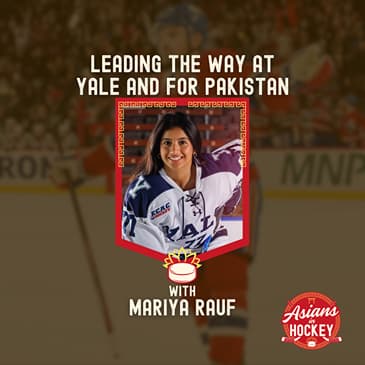




In today’s episode, we’re joined by Mariya Rauf, captain of the Yale Bulldogs women’s ice hockey team and the first South Asian woman to captain an NCAA Division I hockey program. Mariya talks about growing up between Ontario and Northern Virginia, coaching Pakistan’s first-ever women’s team to a bronze medal at the LATAM Cup, and what it means to be the role model she didn’t have growing up.
Plus, we catch up on the latest news from Asian players across the NHL, PWHL, and college hockey.
Mentioned in this episode:
NHL.com Color of Hockey: Mariya Rauf a role model for Pakistan women: nhl.com/news/color-of-hockey-mariya-rauf-role-model-for-pakistan-women
New Era Hockey Training | newerahockeytraining.com
Pakistan Ice Hockey | @pakistanicehockey
Mariya’s links:
Instagram | @mariya.rauf
Yale Women’s Ice Hockey | yalebulldogs.com/sports/womens-ice-hockey
--
Asians in Hockey is produced by Nate Nakao. Contributing producers are Chad Soon and Chris Woo. Theme song by NHLBlak58.
Visit our website asiansinhockey.com. Follow us on Instagram at @asiansinhockey, Threads at @asiansinhockey, Facebook at fb.com/asiansinhockey, and Bluesky at @asiansinhockey.com. Email us at contact@asiansinhockey.com.
Asians in Hockey is part of the Potluck Podcast Collective. Visit podcastpotluck.com for more.
Asians in Hockey is now a community partner with Moonshot, helping to elevate the profile of Asians in sports. Visit meetmoonshot.org to learn more.
[00:00:01] You're listening to... Whoa! Potluck. Welcome back to the Asians in Hockey podcast. As always, I'm your host, Nate Nakao.
[00:00:29] So we're a few weeks into the NHL season and as a Habs fan, it's already been a roller coaster for me. There's a lot to be excited about, sure, and a lot to be frustrated about, but this week in particular brought some news about our unofficial podcast captain that was honestly pretty hard to hear. I'll catch you up on all of it after the break. Now, on a personal note, my master's capstone project is in full swing, so thank you for your patience as the episodes come out a little slower this season.
[00:01:00] My thesis is topically relevant to this podcast, so when I'm finished with it, I'll share it on the website, AsiansinHockey.com, and on social media. It should be wrapped up sometime during the first week of the PWHL season, so stay tuned for that. There is a lot to look forward to over the next couple of months. The Women's World Championship starts in Denmark on my birthday, November 6th, and for the first time ever, it's being played in November instead of during the spring.
[00:01:28] And then, the PWHL drops the puck on season 4, the first weekend of December, with four brand new expansion teams. And yes, I am, of course, still drinking the Siren's Kool-Aid, so you know I will do my best to be at the home opener at the Prudential Center on December 6th. I have a family event taking place that weekend, so I'm not 100% sure if I'll make it just yet, but I will certainly try. I've already got my tickets anyway.
[00:01:55] Okay, before I get ahead of myself, let's get this intro out of the way. As always, I do have just a few favors to ask of you. First off, if it's safe for you to do so, could you take out your phone right now and send this podcast to one or two of your friends? One of the best ways we get the word out about the show and build this community is through word of mouth, so we would love it if you could help us out just by spreading the word.
[00:02:21] Second, it would be fantastic if you could post a quick five-star review of the show on Apple Podcasts. This is honestly one of the best ways to help build our audience on all of the podcast platforms. And to those of you who've already left a review, thank you so much for your kind words. Third, if you've been listening for a while and you'd like to help us out with some of the production and hosting costs, you can do that through buymeacoffee.com.
[00:02:50] Just head over to buymeacoffee.com slash Asians in Hockey to make a donation. And as a gift, I will send you one of these cool Asians in Hockey podcast stickers if you donate at least $5 US. Just send a message through Instagram or on Asiansinhockey.com so we can be sure to get you your sticker. Oh, by the way, I want to shout out Mike Chow, who is our first Asians in Hockey member.
[00:03:17] Mike, your stickers are on the way. I'm just waiting for more to show up from my supplier and once they arrive, I'll get them over to you post haste. And finally, we would love to hear directly from you with your thoughts, stories, and feedback. You can get in touch by visiting Asiansinhockey.com slash contact and sending a voice note or an email. We might even read your message or play your voice note on an upcoming episode, with your permission, of course.
[00:03:46] Now, on today's episode, I'm joined by college hockey trailblazer Maria Rauf. Maria is a forward with the Yale Bulldogs who hails from Virginia. And this season, she was named Yale's captain, making her what we believe to be, as far as we've been able to find at least, the first South Asian woman to captain an NCAA Division I hockey team. But before we get into all of that, let's hear from one of our fellow potluck podcasters.
[00:04:16] And when we come back, I'll catch you up on some Asian hockey news. We'll be right back. Ryan, did you go to Saturday school as a kid? I sure did. Did you?
[00:04:46] Totally. Well, at our podcast, Saturday School, we don't teach a language, but we pass along the culture that we do know. And that's Asian American pop culture. Ada's a journalist, and I'm a professor and film festival programmer. We've watched a lot of great Asian American movies, and we want you to watch them, too. Come listen to us as we look back at the pioneering films that have led us to today. Okay, let's start this segment with the news I teased at the top, because honestly, it's been weighing on me the past couple days.
[00:05:14] So on Thursday, the Canadians announced that Nick Suzuki will be out two to four weeks with an upper body injury. That means our unofficial podcast captain is going to miss the first game of his NHL career. Since making his debut with Montreal in the 2019-2020 season, Suzuki had played 546 consecutive games.
[00:05:40] That was the second longest active streak in the league, behind only Brent Burns, and it was the 20th longest streak in NHL history. It's a tough time for it to happen, because he was off to the hottest start of his career. He had 12 points in 9 games, 5 goals and 7 assists. Earlier this month, he became the fastest Canadian to reach 10 points in a season, since P.K. Subban did it in 7 games back in 2013-2014.
[00:06:11] Suzuki ties Subban, Andre Markov, and Brian Savage, who all reached 10 points in 7 games. Saku Koivu is the only Habs player in the modern era to do it faster. Even in his last game before the injury announcement, a frustrating and devastating overtime loss to San Jose, Suzuki still had a goal and an assist for two points.
[00:06:37] Watching that game, it looked to me like it might have been a shot he blocked with his left hand, but the team has only said upper body, so we'll leave it at that. The Habs will have to get through the next few weeks without their captain, including the Heritage Classic against the Jets in Winnipeg, which is probably one of the more heartbreaking aspects of this to me. So I was watching a reel from the Habs' social media, showing some of the boys looking at the new Heritage Classic jersey,
[00:07:08] and Suzuki had this to say. I always dreamed of playing outside, so it's nice that we actually get to do one. I've been waiting. Ugh, it makes me so sad now to hear it. I do hope he's all healed up by the time the Habs come to Jersey. I've got tickets to their game here at the Prudential Center just up the road from me on November 18th, and I would love to see him again in person. Though, of course, my attendance isn't the priority Suzuki's recovery is.
[00:07:38] Get well soon, Nick. We'll be counting down to the days. Now over in Pittsburgh, Nick Robertson is making a strong first impression with his new team. After being traded from Toronto this summer, he scored twice in the Penguins' season opener, a 7-0 win over Philadelphia, and he's kept producing since. He started on Sidney Crosby's line before getting moved down to the fourth line,
[00:08:07] but he still found the back of the net, including a goal against Chicago on October 13th. His brother Jason is, of course, one to watch all season for reasons beyond what happens on the ice. After a long off-season of trade rumors, he signed a one-year, $12 million deal with Dallas. Now unless he and the stars agree on an extension, he'll be a free agent next summer. He reportedly turned down a trade to Seattle that came with an eight-year deal,
[00:08:36] so it kind of sounds like he wants to stay in Dallas. I personally would love to see him move away from that organization, but we'll see how this plays out. And on the ice, he's starting to heat up, of course. After a quieter first week, he put together back-to-back two-point games. He had a goal and an assist in a 4-0 win in Chicago last Saturday, and then two assists, one of them on the power play, and an overtime win over Boston on Tuesday.
[00:09:03] That gave him nine points in his first nine games, three goals and six assists, and he was leading the stars in goals heading into this week. A couple of last June's top draft picks are starting their college careers this fall. Caleb Malhotra, son of Vancouver head coach Manny, who the Canucks took third overall, is a freshman at Boston University. And Ryan Lynn, a defender the Sharks traded up to take at number 21,
[00:09:30] is a freshman on the blue line at Denver. Now, like we mentioned last time, Lynn's dad is Canadian of Japanese and Taiwanese descent. We'll, of course, be keeping an eye on both of them. Now, on the women's side, the IHF World Championship is coming up fast. Japan is in Group B with Canada, Finland, Sweden, and host Denmark, and opens against Denmark on November 7th. Japan also has a new head coach, Tomohito Okubo,
[00:10:00] who replaces Yuji Izuka. Canada named its roster this week, and it's a much younger group than the one that won silver at the Olympics back in February. One name I was, of course, happy to see is Nicole Gosling, who's back with the national team after being left off the Olympic roster. And it's been a busy year for her. After winning the Walter Cup with a victoire and being named a Rookie of the Year finalist,
[00:10:28] she signed a three-year deal with the expansion team in Hamilton, which is, frankly, really annoying for me since Montreal is the other team I root for in the PWHL. Speaking of, the PWHL drops the puck on Season 4 on December 5th, and there are a few players we'll be following, of course. Out in San Jose, goaltender Tia Chan is starting her pro career. Now, as we mentioned last episode,
[00:10:55] Tia was the National Goalie of the Year at UConn last season, and she also represented China at the 2022 Olympics. San Jose drafted her in June and signed her to a three-year deal last month, which, as a Sirens fan, still frustrates me that we let her fall to San Jose in the draft. Her team hosts the Minnesota Frost on opening night. In Vancouver, Katie Chan is back with the Golden Eyes after re-signing for two more years.
[00:11:25] Last December, she scored her first PWHL goal in front of the home crowd at the Pacific Coliseum. Her teammate, Anna Segetti, is also back. Anna was born in China, grew up in Michigan, and played for China at the 2022 Olympics. She became the first China-born player in PWHL history, and as a Sirens fan, I vividly remember her first PWHL goal, which came against us back in March. Vancouver opens the season at home against Seattle in their brand new threads,
[00:11:54] which, I have to admit, is probably my favorite kit in the league. Give your jersey designer a raise, Vancouver. Elsewhere in the league, Akane Shiga, who made history in 2024 as the league's first Japanese player, is back in the PWHL. She spent the last two seasons with Lulio in Sweden and signed a two-year deal with the expansion team, PWHL Detroit. But first, she will likely be a key piece for Japan
[00:12:23] at this year's world championships. Detroit opens on December 6th in Las Vegas. All right, that's it for this week's news. We'll take a quick break, and when we come back, we'll hear my conversation with Yale Captain Mario Rauf. Hey, I'm Phil Yu, and you may know me from a blog called Angry Asian Man. And I'm Jeff Yang, author, journalist, and celebrity dad. We host a podcast called They Call Us Bruce,
[00:12:53] an unfiltered conversation about what's happening in Asian America. Each week or so, we host a discussion about some of the most vital and interesting topics in our pop culture and our community, bringing in guests who are shaping and informing this thing called Asian America from Hollywood to D.C. and beyond. We got media, entertainment, food, family, politics, representation, the good, the bad, the WTF of it all. So check us out wherever you get your podcasts or at theycallsbruce.com. Peace. Peace.
[00:13:24] Welcome back to the show. My guest today is Mario Rauf, a senior at Yale and captain of the Yale Bulldogs women's ice hockey team. She was recently named captain for this coming season, the 26-27 season. Um, she plays on the wing, which means, uh, I guess on my hypothetical imaginary Asian hockey team, um, I will be riding the bench while you occupy the first line. Maria, it is such an honor to have you on the show. Welcome to the Asians in Hockey podcast
[00:13:54] and thank you for joining me today. Thank you for having me. So, um, take us back to the beginning. When did you first encounter hockey and how did you find yourself getting involved in the sport? Yeah, so from a very young age, I was just watching a lot of hockey. Um, my brother actually played before me and so we were living in Virginia and so he started playing and I just started watching the Caps because that was our local team and I was lucky to be, you know, watching them at the time that Ovechkin was really getting, you know, into his prime
[00:14:24] and so he was obviously my favorite player. Um, and so from there, I just got really invested in the Caps and Ovechkin and I just, you know, couldn't really stop watching hockey. And then when my brother started playing, I was going to all of his games, just sitting up in the stands watching him. And then from there, I always like wanted to play, but, you know, I didn't know how to skate and I was still very young. So I just played a lot of like mini sticks and played in the basement with my brother a lot. And then eventually my parents, um, you know, put me into figure skating to at least get me on the ice and learn how to actually, you know, be on the ice.
[00:14:52] Um, and that's kind of when I started to, you know, be able to actually skate and get more into actual playing hockey. Oh, that's so interesting. So, um, I, I, in looking up your biography, I did notice that, um, you had spent some time in Ontario. Um, now take us through a little bit of that timeline as well, because Ontario is, um, almost the center of hockey culture. And then, um, you moved to Northern Virginia, I guess somewhere in the DC area,
[00:15:19] which is, um, probably safe to say not exactly a hotbed for hockey culture. Um, so how did that transition from like a hockey saturated culture, um, to one where the sport is a lot less visible? Um, how did that shape you as a hockey fan and, um, you as a player as well? Yeah. So originally I was born here in Virginia and then we actually moved to Canada, um, which is where I started. Like I started figure skating here in Virginia. I see.
[00:15:49] The time I was first on the ice. Um, but when I actually started playing like real ice hockey, that was in Canada and that's when I actually started to play. Um, so I moved there when I was about six and we lived there up until, um, I was about 11 or 12. So we spent a good amount of time there. Um, that's really where I started to learn how to play. And then, you know, coming back was definitely a different experience because, you know, when I was here already, it was like, there was nothing here in Virginia really for girls at that time. And it's grown a little bit more now. It's actually become a little bit more popular, which is nice to see.
[00:16:17] But at that time it was really, there wasn't really anything here. And so we moved to Canada and then, you know, once I moved there, it was like, there's like everything, like five minutes away from me, there's like a rink here, here. Like there's so many different options. And so it was like, I was so excited to have that opportunity and to actually be able to play, you know, real hockey. Um, and then moving back here, I was, you know, obviously at the beginning, I was a little upset because I was like, you know, I don't want to leave this place where I have all these, you know, opportunities to play and going back to a place where I know it's not going to be as, you know, convenient
[00:16:46] and I'm going to have to drive an hour just to get to practice. But, um, you know, we moved back and it was, it was a good experience. I played for a boys team for a little bit and then played for some local girls teams. But yeah, no, it was definitely different coming back here for sure. You know, coming from a place like Toronto, like you said, to Virginia, but you know, it ended up working out, I think. Gotcha. And that, that totally makes sense. But that is interesting to hear your story of your transition and the differences between the two, uh, the two parts of the continent.
[00:17:13] Um, so at the, at the youth level, um, like you said, you played both in Canada, um, and in the U S. Um, so speak a little bit more, um, if you could about the transition. Um, how did that shape your understanding of, of different hockey cultures? Um, you know, and I believe you're a dual citizen if I'm not mistaken. Um, so how, how did playing in both countries, um, shape your sense of identity in the sport? For sure.
[00:17:42] I think for me, like moving to Canada, it kind of, and playing with those girls in Canada kind of forces you to, to play at a higher level just because everyone around you is so much more skilled. Um, and you know, originally when I was, you know, when I, when I came back here in Virginia, it was definitely, I wouldn't want to say a step down, but it was definitely like a noticeable difference. Um, you know, there's, there's just at that time, you know, it's growing a lot more here, which is nice and it's getting a lot more competitive. But at that time it was definitely, you know, there was definitely a big difference between the youth level in Canada versus the youth girls here in Virginia.
[00:18:12] Um, so the difference was definitely noticeable. And, you know, at the time it was like, for me, I was, you know, I wanted to play with the best people in the area just to get better myself. And so that's why when I came back, I played boys for a year because that was, you know, the best opportunity for myself and, you know, my family and for me to, to really get better. Um, but yeah, like you said, like, it's just, it's just coming from a place like Toronto, it's like, you can't really, you know, escape hockey. And so you obviously expect everyone to be really good. Um, and so I think for my development, that was just a really good time to, you know, actually be able to like
[00:18:42] learn and grow. Cause that's such a good, like a fundamental part of your, you know, growth at the age that I was learning how to play hockey. And so learning in Canada, I think was, was really good for my development. And I had some really good skills coaches that, you know, had, you know, really good insight. And that taught me a lot of really important things. And, you know, even coming back here, there were, there were a lot of good coaches like my skating coach. Um, she actually coaches with the Washington Capitals. Her name's Wendy Marco. Um, and she was probably one of the best coaches I've ever had. And, you know, she happened to be here in Virginia. And so, like I said, like it's, that's definitely, you know,
[00:19:12] different here, but there are still a lot of good opportunities, which I think both, you know, played a really huge role in my development. Um, and, and I, I do like to also hear, um, that there are more skating coaches kind of, um, popping up around the NHL. I think that's such a huge, hugely important, um, aspect of, of the sport that often, that often gets overlooked. Um, For sure. Yeah. And, uh, there's a Japanese Canadian woman up in Calgary. She is a skating coach with the Calgary Flames. Um, but I had her on the podcast as well.
[00:19:42] And she tells her story about, um, just the, the changing systems in, uh, at that high elite level of hockey where, um, skating, which is often overlooked is now becoming kind of a focal point of, um, player development. And so I think that's, that's so important. And it's cool that you had somebody that, uh, really worked with you in, in that area. Um, so we'll transition a little bit and I want to talk a, um, a bit about, uh, sort of, um, your racial identity
[00:20:11] in hockey spaces. So like growing up, what was it like being Pakistani in hockey spaces? And, and, um, did you have anybody that you looked up to either, um, at the NHL or NCAA or any other, um, high level hockey that you saw either on TV or in, in the rink that you watched and, and, and, um, wanted to sort of model your, your game and identity after? Yeah. Unfortunately for me, there weren't really, you know, any really Pakistani
[00:20:40] or South Asian women growing up for me that I could really look up to. Um, you know, I obviously had, I've looked up to Marie-Philippe Lynn and players like that, but, you know, obviously no one that really, I like identified with. Um, and so it was, it was definitely an interesting experience and I think as a kid I didn't really notice it, but as I got older I think I became more aware and, and I was just like, not uncomfortable, but there were definitely times where you'd think like, you know, I'm the only one that looks a little bit different. Like, you know, does it, do I really belong and things like that? Um, and, you know, it was everyone
[00:21:09] that I've ever played with has always been so nice and I've never had any issues, which has been great, but, you know, it's definitely something that like I wish I had was, you know, having a group of girls or just someone to look up to that, you know, I realized like they, like they look like me and they can do this, like maybe I can do it too. Right. Um, so it was just definitely a little bit different, you know, not, I don't want to say it was like uncomfortable or anything, but you know, it was just, it would have been nice to have someone at that time that was, you know, a prominent, like South Asian woman in hockey, but you know, at least it's growing now
[00:21:39] and there's definitely been a lot more. So I'm glad for the younger generations that they're going to have so many different girls especially nowadays these last few years with the growth of the PWHL and, um, I, anybody who's listened to the show for a long time knows I'm, I'm that big NWHL fan but I do have to admit that like the PWHL has done something for women's hockey that the NWHL just never really could. Um, so you have talked in,
[00:22:08] in other spaces about, um, wanting to be that person for, for young Pakistani and South Asian girls. Um, and like you just mentioned here that you didn't have someone yourself looking up to, um, but, but in other spaces I have read that you've, um, you've sort of wanting, wanted to kind of take on, on that role. Um, when did that sense of responsibility really begin to crystallize for you? Yeah. I think kind of when I got involved
[00:22:37] with the Teen Pakistan stuff, I think that really opened my eyes to like seeing there's like a young group of girls that all, and you know, they'd all heard of my story and, and the, you know, the guy that introduced me to the whole program was telling me that, you know, all these girls are really looking up to you. And for me, I was just, you know, really proud to hear that. And like, I never had thought about that. Like, I'd, I'd never thought that girls would look up to me as a, you know, as someone to, to model their, you know, game after or whatever. But just hearing that kind of made me like take a step back and be like, oh, maybe this is like something that I could really, you know,
[00:23:07] do and be that sort of model for those girls. And so I think that's kind of when it started. And then, you know, just obviously being the coach for that team, it kind of forces you to be more of like a mentor and kind of be in more of a leadership role. And so that's kind of when I was like, you know, this would be something that, you know, I really want to do and I really want to be there for the, for the girls that, you know, look like me when I was younger, just for them to have that person to look up to. So, um, you, last summer, was it last summer? Um, you coached
[00:23:36] Pakistan's first ever, uh, women's hockey team, um, at the LATAM Cup and you led them to a bronze. Um, walk us through a little bit about how that came together. You alluded to it, uh, briefly just a moment ago. Um, but, uh, like I said, walk us through how that came together and, and what it felt like to be on, on that bench. Yeah, for sure. So they had had a men's team a couple years before. Um, but the main guy that runs it, his name is
[00:24:06] Donnie Kahn and he works in the NHL and he, he found out about my story through like a local, uh, or a mutual friend. And so he reached out and he was like, you know, we really want to start a girls team and, you know, we need a head coach and we were wondering if you want to do it. And I'd never coached before. So I was a little bit, you know, nervous because I was like, I've never really had to be on the bench. Like I've always been out there playing. And so it was, it was a new experience for me, but obviously I was really excited just to hear about the opportunity and having the Pakistan ice hockey team be a thing. I was like, you know, this is obviously so special.
[00:24:35] And so I said yes, obviously. And, um, it was a really, really good experience for me. I think, I think it kind of forced me a little bit to come out of my shell as more of like a leader, which I think was, was really good to have really good experience. Um, and just like seeing the girls all come together and like we had only, I think, 12 skaters. And so we, you know, it was five on five with like 12 skaters and basically the girls were going out there every other shift and I know they were exhausted, but just seeing them like fight through that, battle through that, just, you know, for a greater,
[00:25:05] a greater cause was like just so special to see. And, you know, at the end of every game, just seeing them come together, all these girls that didn't even know each other before and that all kind of have each other to look at that looks like them and, you know, feels like more of a family than, you know, just a team. Um, it was just really special and just like after we won, kind of seeing like all the families and everyone celebrating, it was just, for me, it was like a very emotional experience, just like, you know, being a young Pakistani girl myself growing up, like if I had had that, like I think I would have really, really, you know, enjoyed an
[00:25:34] experience like that and so I'm not jealous but I am really, you know, I do think it's really special that they have this opportunity with girls growing up. That's so, that's so incredible and as a coach sometimes, you know, you live a little bit vicariously through the experience of your players. Yeah, for sure. I, I coached U12 for a few years here in New Jersey and just that, you know, I was never a good player. Let's, let's not mince words here. But,
[00:26:04] having the ability to kind of watch the kids out there at an age where I wasn't very involved in hockey at that stage of my life and so, but that's kind of an age where I feel like I would have loved that kind of thing. So, you know, working with those kids has been a blast. So I can imagine like watching those girls out there and working with them and seeing their experience though, 12 skaters, oh my gosh. It was, I don't know how they did it. I was telling every single game,
[00:26:34] I was like, I don't know how you guys are doing it, but just keep doing it. It was awesome to see that. I know. I'd be like, you can skip my shift, please. I know. Thankfully, this summer we're going to have a full team. So I'm excited to see that. That's awesome. That is really awesome. So as we're going through your story a little bit, it's pretty obvious you're navigating hockey as both a racial minority and as a woman. And these are two things that don't often get talked about together.
[00:27:05] Conversations about women's hockey tend to center gender at the exclusion of race. And South Asian hockey conversations tend to center the stories of South Asian men women at the expense of a conversation about South Asian women. How has that intersection shaped your own experience? Yeah, for sure. I think for women it's kind of already hard enough to be a woman in sports with how it is these days. I'm glad that it's
[00:27:35] been growing a lot, but just from the past it's been hard to be a woman growing up in the sports space. But adding in that racial minority aspect is also another thing to think about. And not something that everyone really has to think about. And so I feel like as a racial minority in sports you kind of feel like it's not a pressure but sort of like a responsibility to carry yourself a certain way and feel like you're putting out a good example and making it feel like you belong there. And I feel like that's just something that I've grown up with is just making
[00:28:05] sure that I'm setting the best example I can for younger girls and for people around me. I want to make myself and make my community proud and make everyone look good. And so I think that's something that I've always thought about is just making sure that I'm representing everyone with respect and making sure that everyone respects me and that I'm handling everything with caution and things like that. But yeah, I feel like it just kind of forces you to just think a little bit more in my example. It's just like you kind of
[00:28:34] think a little bit more about what you're doing and what you're saying around people just because you want to carry yourself a certain way. Yeah. And it's kind of a point of frustration because these are things that most others don't even have to think about in a sports dressing room or locker room. It's just an additional I don't want to say it's a barrier but in a way it can be because there are certain people who just would never want to even bother with going
[00:29:04] through those kinds of things. And so to have that added amount of I guess it's not necessarily like you were saying not necessarily pressure but it is that sense of added responsibility that most other people never imagine experiencing and going through. So kudos to you for doing that and for stepping up to the plate. And then on top of that this past season
[00:29:34] we're going to switch gears just a little bit and talk about your team for a moment. So this past season Yale won the ECAC regular season championship so congratulations on that. You were a big part of that. So what stood out to you about that team and that run? Yeah I think honestly from my past three years at Yale I think this was the closest team that we've ever had. I think everyone was
[00:30:04] interacting with everyone. The freshmen weren't scared of the seniors and things like that. Everyone was just getting along really well and I think that plays a huge factor. Obviously there's a lot that happens on the ice but I think if you're a little bit disconnected off the ice it can really play a big factor in how you guys perform. I think the fact that our team was so close and everyone was comfortable with everyone I think that really played a huge role in our success. We hadn't won in the past and I think that
[00:30:33] definitely shows that we had a really good culture this year. Absolutely. Absolutely. What I was alluding to just a moment ago after this incredible run that you had your teammates selected you to be captain for the 2026-27 season and with that you became the first Pakistani and first South Asian woman to captain an NCAA Division One hockey program and that's to be fair that's as far as I was
[00:31:03] able to determine from my research there's not a whole lot of information recording particularly when it comes to Asian women in NCAA but as far as I can tell you are the first. So what did it mean to receive that honor from your teammates and what does this milestone mean to you beyond your career at Yale? Right. I think it definitely meant a lot to me and I don't think I really expected it to
[00:31:33] be honest with you but I think coming from my teammates it really means a lot just knowing that they all trust me and they all respect me enough to vote for me it's like we can only have one captain and so just knowing that they all picked me and they all really trusted me it meant a lot just again like coming from your teammates that's definitely something that you want to hear and knowing that they trust you and have respect for you it just again it just means so much and then just like you know being that example for the younger South Asian girls I think just showing them that it's
[00:32:03] possible and that you know any of them could be a captain assisting captain or just a leader in general like you don't need to have a letter to be a leader and I've always thought that and so I think just you know showing them that they can step up and be a leader as well it's it's something that I'm glad that you know I'm really excited to have that opportunity and I'm hoping that it just you know paves the way for the girls below me and that they can all you know step into that role wherever they end up no absolutely so in in a player profile that I read
[00:32:31] about you coach bolding talked about you kind of bridging the gap between the older and the younger players what does that leadership role look like to you and what are some of the goals that you have for your time as captain this season yeah for sure I think for me just someone you know I think my sort of leadership style is like more of like a community building and kind of like a family and like again like I said like our team culture last year was so good that you know I just want to build off of that and I think you know I'm not someone that's gonna just yell at you or you know
[00:33:01] know be hard on you and things like that like I think that you know for me I'm just my biggest goal is to be a good teammate and make sure that you know everyone feels welcome and feels respected and that no one person feels less than another just because of playing time or you know skill or grade or things like that so just making sure that everyone feels that they play a huge role on the team regardless of you know how much they're playing or you know if they're scratch or things like that I think is kind of my main goal is to just make sure we're connected and make sure that everyone is comfortable and you know not afraid to
[00:33:31] speak up I think that's just something that's so important for a team to be successful yeah absolutely yeah and I think for goals I think you know I've never won the Ivy League and so I really want to I think that'd be a really awesome experience and I think we have you know the ability and the players to do it so that's definitely a goal that I think our team would have and that I think I think we're very capable of achieving and then you know from there just you know winning just keep on winning and making it to the tournament and you know big goals from there so I'm just excited to see you know I think we have a really good class
[00:34:01] coming in so I'm excited to see you know how we do yeah well good luck to you I'll be rooting for you and your team and it makes it easy because you're I wouldn't say right in my backyard but New Jersey to Connecticut isn't exactly too much of a hike so yeah and I do occasionally make the trip out to New Haven you know I know I know my state has some beef with your state over something that your governor said a few years ago about pizza pizza but I will give it to New Haven that
[00:34:31] that town does have some pizza that can compete with what we have here in Jersey so yeah it does so according to your Yale bio page you were planning on studying psychology is that still a case and if so what does that lens kind of show up in how you think about the game about maybe your team dynamics and about your own performance on the ice yeah I think you know as someone that studies psychology I think it does kind of
[00:35:00] make you a little bit be more a little bit more thoughtful and you kind of like you know put a lot more thought into you know why is something happening a certain way or you know why is someone thinking a certain way so I think that also kind of makes me more you know like I said my leadership style is more so like building a community and building a family so I think that also kind of plays a huge role because with psychology obviously you know it's it's about studying people and how people think and how people react and so I think that's definitely kind of why I take that sort of approach to to leadership but yeah I
[00:35:29] think again it just kind of makes you more thoughtful like with me it's just like you know why are coaches saying a certain thing or why is a player playing a certain way and things like that I don't know if it's just because I'm just more of like a you know inquisitive person but it's I think it just is maybe that's why but yeah I don't know I think it just makes me a little bit more thoughtful and think a little bit deeper yeah and that's really fascinating because I often do think along some of those lines as well just sort of asking those kinds of questions like why is somebody approaching the
[00:35:58] situation in this way you know and and for for for good and bad because you know right exactly as we've learned in like you know studies about positive reinforcement versus other coaching styles that may yield results but long term we're seeing some of the negative impact of of some of the more traditional coaching methodologies so that is fascinating and you're sort of asking those more holistic questions about
[00:36:28] beyond what is this doing for the team on the ice and more what is this doing for the person in their life and how is their how is what's happening in their life impacting their performance on the ice so yeah and I'm also curious too now that you're entering your your final year of of college when your time at at Yale or at least your time in undergraduate is done what does what is the the chapter after it
[00:36:57] look like is it is it going to be more school are you thinking of maybe going for the draft is there besides all of that is growing the game for South Asian and Pakistani girls something that you see as kind of a long-term part of your story yeah definitely I think with the Pakistan stuff I think for sure I want to be involved with that as long as I can I think you know we have a lot of bigger goals that we want to achieve with that with that organization I think eventually want to make it to higher levels and playing at bigger
[00:37:26] tournaments and that's definitely a big goal that we have and we can definitely see it coming true soon so definitely want to be involved with them as long as I can I think also we've talked about this briefly me and Donnie is you know maybe one day actually going over there and doing some sort of a camp or something like that out there because they do have a up and closer up to the mountains they have an outdoor rink and so you know doing something over there would be really cool and I think that'd be something that I would want to do you know once I'm a little bit further out of school and I actually have the time
[00:37:55] to do it I think that'd be great to do just to actually bring the game there would be would because they've obviously really never seen it over there and so you know for them to have that in person I think would be really cool and then hopefully you know it could inspire them to start playing and you know maybe have a team there or something like that I think that'd be really cool yeah I just yeah that'd be great but I think for me you know like you asked for you know post-grad I think you know with the new NCAA rule I technically do have a fifth year and so I don't know exactly
[00:38:25] what I'm going to do you know there's there's a lot of unknowns but you know I would you know consider getting my master's but you know I think just pursuing you know higher education as well and then you know seeing where hockey could take me as well it is something that I'm really interested in you know I want to play for as long as I can you know obviously I'm not ready to give it up yet so I think just you know it's it's a decision that'll come a little bit later but you know there's a lot of different opportunities that I could pursue so I'm excited to see yeah it is cool it's cool to that you have these
[00:38:54] options now that you're in a position where like women's hockey is growing so you can look to the future and and have some aspirations there and at the same time you know you're in a like I'm also a very big proponent for higher ed I my in my my day job I work in higher education so I'm always like keep stay in higher ed stay in this world it's such a great environment to be in so and it gives you the opportunity to continue exploring your passions elsewhere you know
[00:39:24] exactly a really good friend of the show Courtney Sito she wrote the book changing on the fly and she's she's in higher ed she studies kinesiology up in I think oh am I forgetting is it Queens College up in Ontario yeah and she's doing a lot of great work in the Asian hockey space and you know there's I think of of people like her but then I also think of we we had Reagan Rust who's a Filipino American and you know she's doing a lot of work just growing
[00:39:53] the game outside of herself just playing but doing her own coaching and working with a little bit with the the Filipino women's team which is really cool you don't imagine like a tropical country having ice hockey but you know they have like one or two rinks there in the whole country and they do get some hockey guys so okay so I want to transition now to a little bit of a rapid fire round so before we close out I ask some of these kind of fun questions to all of my
[00:40:23] guests so I'm curious about you okay so most Asian cultures have very distinct cuisines what is your favorite Pakistani or South Asian dish and why it's tough I think there's so many there's so many good dishes I think my favorite it might be a little bit controversial but it's a it's a spinach dish it's called sog and I eat it you eat it with like roti or naan okay and my grandma has made it for for a long time for me and she makes it really good and my mom too and so that's
[00:40:52] kind of why it's just it's just to me it's really good I love how you said controversial but you're talking to somebody who loves spinach so it's not so controversial in my book I think of either way some people don't love it yeah yeah that's true that's true it's it can be an acquired taste right yeah okay so um do you have a go-to pregame meal or are you the type of person just throws an energy bar into your bag and calls it a day with Yale we actually get pasta and chicken I think pretty much every single game okay okay so we play Friday so Friday we get
[00:41:22] grilled chicken and pasta and salad and bread and things like that and then Saturdays we get it's like a breakfast because our game's at three so we get like a brunch sort of thing so it's like eggs potatoes pancakes things like that and honestly I think those are my favorite I kind of prefer that over the pasta and chicken like if I could have the eggs potatoes pancakes before Friday games I probably would um it's just a personal preference I don't I just really enjoy it more but gotcha yeah that's so it's kind of I don't get really get to choose my pregame meal so it's kind of what I'm given and
[00:41:51] it's honestly both of them are great so I enjoy both cool cool okay so um what is your skate hollow um do you prefer having a little bit more bite or more glide on the ice and um how did you come to that was it but through feel or were you like okay I weigh this much and I play this position therefore this is my skate hollow honestly I've always just used half inch I think that's just like the original one that you that comes with um I think it just gives you more glide if I'm not I don't know I can't I don't know the exact I don't think I
[00:42:20] think 716s gives you more of like the the bite that you're talking about yeah um I tried it once but I didn't really enjoy it that much I think I think maybe because I was so used to the other you know style it kind of just threw me off a little yeah but yeah um yeah I think it's just it feels more comfortable and it's just like since I started that's what I used and so I think I just never really just thought to like try something else so gotcha gotcha I'm a five-eighths person so it's a little bit more glide um but you know I whenever I end up with
[00:42:49] half inch I feel I feel like I'm gonna like end up digging into the ice and breaking something so does half inch give you more of like a from my perspective I guess because it's um because I'm I got so used to five-eighths that now half inch feels like a little too much bite for me but I can I can see how like for for somebody who's just used to half inch going the other direction yeah um is gonna is gonna feel more like more more bite and then coming towards my direction you're gonna feel like you're just slipping and sliding around
[00:43:19] everywhere so I know uh goalies use five-eighths because my brother he was a goalie and he used five-eighths yeah uh one of my friends who actually got me into um got me to switch to five-eighths also plays goalie he okay yeah he's up up front a lot but like you know he played goalie for a whole bunch of years that's just his skate hollow so he's like use five-eighths if you're having trouble stopping I'm like okay sure um okay so let's talk um tape job heel to
[00:43:48] toe or toe to heel and why I go heel to toe and I do about like half the blade I don't take the full blade I leave my heel pretty pretty open okay so it's like mostly just the tip honestly okay so toe to heel and then halfway and you stop it at the yeah but I'd go like I'd go from like where like I go from if I was doing heel to toe oh okay gotcha I'm gonna go up towards the toe gotcha so it's yeah heel to toe but you don't start at the heel you go I don't I start like halfway gotcha middle to toe okay
[00:44:18] okay makes sense I like how I like how it feels like with the like stick handling with just like the heel of the blade without the tape on it I don't know I just like how that feels I've never tried that yeah I've always just like left a lot like I used to honestly it was a lot more aggressive when I was younger like it would basically just be the toe but I think I've gotten I've got it's gotten a little bit longer as I've gotten older gotcha gotcha and I I've also seen like in in hockey subreddits like it's people people are are vitriolic if you go the the wrong direction
[00:44:48] quote unquote they're like I've never heard of anyone going toe to heel is that like a common thing no I don't think it's common but I see people defending it like crazy um I I'm I'm heel to toe but I'm heel to toe the entire um okay yeah the entire blade but like I I don't I don't understand like what the logic is there because I don't either wouldn't your tape job get really messed up every that's what I would think I don't really yeah I'll try it one day and yeah okay so do you have a pregame playlist or
[00:45:18] do you prefer prepping in silence um and if you have a pregame playlist who's on it uh okay I actually am the ox person in the locker room so I play the music for us okay okay so I do have the playlist but um personally I I just play a lot of Drake I love Drake and he's you know growing up in Canada like he was my favorite artist so I play a lot of Drake and like rap just to get the girls hyped up um I also play some like house music I think our team really likes house music now it's like become a lot more popular um and so we
[00:45:47] we've gotten into that a lot um so it's mostly just like rap house music and like just like pop music I guess okay um that's kind of mostly it but definitely no country not on the game days right right yeah I feel like that would be uh that wouldn't be much of a hype mix for me no exactly sometimes they play it during lift and I'm just like I don't I can't do this okay and um finally if you could play one game alongside any player in hockey
[00:46:17] history who would it be honestly I think it'd have to be Ovechkin just because he's really like the reason I got into hockey okay so I think it would be like a really you know like I used to be number eight just because he was you know obviously and I had like yellow laces and I was like a really big fan of him nice big poster so I think it would definitely have to be Ovechkin just you know for my childhood sake yeah no I've made that makes total sense um and I every time I think of Ovechkin I
[00:46:45] think of that um I don't know if it was 90s or or um early 2000s probably early 2000s the sports center commercials um and there was the one where Ovechkin was like in the office like making copies on the on the copier yeah and then he like hooks himself up to like some spy in the ceiling yeah that's a good one yeah every time I think of Ovechkin that's like the first thing that pops in my mind is that commercial yeah I know he's he's unreal yeah yeah no
[00:47:15] absolutely um um if I were to to respond to that myself I think um similarly it would probably be probably be Paul Korea I think it would just be fun to have you know being half Japanese myself just be fun to have somebody else on the ice who's half Japanese yeah um along with me and just to I always loved that play style he's a finesse player um and I didn't really watch him a whole ton when I was
[00:47:44] growing up but what I did catch of him was really really fascinating and then I think that was the style that really got me into watching hockey was that speed and finesse and that to me was so cool um less the the hits and the physical play I didn't find that much yeah I don't either yeah yeah yeah so so yeah somebody like Paul Korea was uh was always fun to watch but um yeah so um before we before we sign off um
[00:48:14] where can people find you online and um if people want to follow you and uh is there anything else that you want to plug maybe any organizations that you're working with that you want to um to mention and I'll put all of these links into the show notes for anybody who's listening like um at your computer or um walking around and you can click through your show notes but for anybody who's driving and can't go clicking through their show notes let's let's shout them out here you think okay recently I'm getting more involved in like coaching in this
[00:48:42] area so um there's a group called new era hockey training DMV so if anyone's in that area I'm gonna start doing like lessons and coaching little camps here so that's definitely something that um yeah I'd like to plug they have an Instagram and then you know I'm one of the coaches on that group um we had a camp last week and that was actually a really good camp so hoping to grow it more hopefully to get more hoping to get more girls involved so if anyone knows anyone in the DMV or or is in the DMV and wants you know to get girls or anyone else in
[00:49:11] hockey I'd love to be love to help there um and then just my Instagram is just my first and last name maria.ralph so m-a-r-i-y-a dot r-a-u-f and then um if you want to keep up with the women's hockey uh it'll be a fun year so you can keep up with them and then also Pakistan ice hockey it's a good we're gonna be up uh this summer so at the end of or at the end of July early August we'll be playing in the latim tournament so they'll be posting a lot about you know our schedule and you know the game outcomes and things like
[00:49:40] that so definitely keep posted with that. Awesome very cool and yeah I will definitely be following and I will see if I can make it I mean it's not that far I should I should just try to make it out to to Yale to go catch a game over there. I mean even Princeton when we come to Princeton. Oh that's true yeah you're right over here yeah yeah so I mean I guess Prince is also a little bit of a hike because I'm I'm in the uh like the New York City area but right it's not that far it's yeah yeah it's probably the closest for definitely the closest will be to you. Cool cool yeah because Princeton's the furthest like I guess north we go.
[00:50:10] Okay yeah that makes sense and I know I know a couple people at Princeton hockey so um I can uh reach out to them and uh we could try to make a day of it so yeah awesome awesome. Well thank you again Maria for for coming and hanging out with me I really appreciate this and good luck to you this season I will um I'll definitely be rooting for you and the Bulldogs um this season and uh we'll be following your career and seeing what you come up to uh next. Yeah well thank you thank you so much for having me and all your very awesome questions. Absolutely.
[00:50:39] Thank you. That's it for today's episode. Be sure to tune in next time when I'll be talking with fellow Sirens fan and queer hockey content creator Joe Liu who's on the creative team at Lavender Line a sapphic fan-led multimedia creative project and production initiative inspired by the queer hockey romance and media universe of heated rivalry. Thank you so much for listening. Asians in Hockey is a part of the Potluck Podcast Collective and is hosted and produced
[00:51:09] by me Nate Nicale. Contributing producers are Chad Soon and Chris Wu. Theme song by NHL Black 58. If you like what you heard leave us a five star review on Apple Podcasts or Spotify and share this podcast with your friends. To keep up with us on socials follow us on Instagram and threads at Asians in Hockey and on Blue Sky at Asians in Hockey dot com. You can also find us on Facebook at Facebook dot com slash Asians in Hockey.
[00:51:38] Please feel free to shoot me an email at contact at Asians in Hockey dot com and don't forget to visit Asians in Hockey dot com for more great content. See you next time on the Asians in Hockey podcast.